Author: Greg Jericho

  • They didn’t cause the inflation, but workers are expected to cure it

    In his Guardian column, Policy Director Greg Jericho notes that given real wages have already fallen for 2 straight years any further falls will take workers’ purchasing power backwards to where it was more than a decade ago. This however is viewed as being “worse than the alternative” of inflation growth above 3%.

    He notes that over the past 2 years the profit margins of many industries, and most especially the mining industry, have risen and have themselves fuelled inflation. But company profits are never expected to suffer, wages however are always viewed as either the culprit of inflation or the means to reduce it. The vast increase in mining profits, largely due to the Russian invasion of Ukraine, also highlights the urgent need for a windfall profits tax.

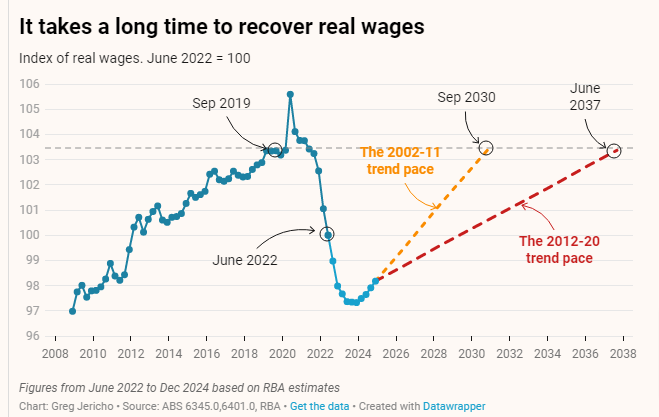
    Using the RBA’s own estimates Jericho calcuates that by the end of next year real wages will be back at 2008 levels and even with the most optimistic outlook they will not return to 2019 levels until 2030.

    The Reserve Bank’s strategy of sharply increasing interest rates risk slowing the economy into a recession even though real wages are already falling faster and for longer than they have in modern times.
    The post They didn’t cause the inflation, but workers are expected to cure it appeared first on The Australia Institute's Centre for Future Work.
  • The latest data shows just how bad housing affordability is

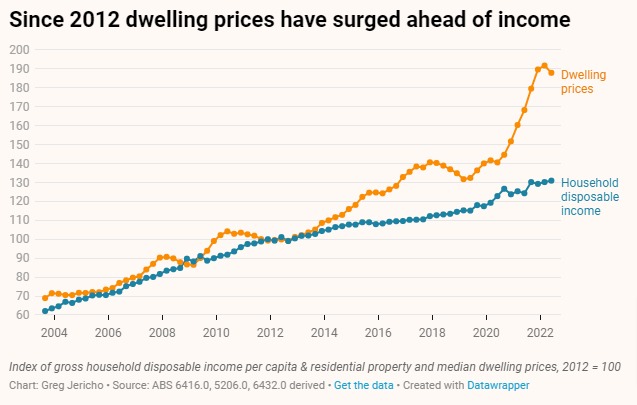
    But while the latest data from the ABS shows prices fell on average 2% across the nation in the June quarter, policy director Greg Jericho notes in his Guardian column that price remains well above what they were prior the pandemic.

    During the GFC the majority of the stimulus measures directed towards construction were on public works – most notably the Building the Education Revolution. During the pandemic, however, the Morrison government targeted the housing market with its HomeBuilder program in conjunction with the Reserve Bank’s cutting interest rates. These served to set fire to the market as prices soared and affordability plummeted.

    In June 2020, the average dwelling price in Australia was $689,400. That was around 13.4 times the average annual household disposable income of $51,487. Now the average household disposable income is up to $56,129, while the average dwelling price is now some 16.4 times that at $921,500.

    Even worse, ten years ago the average dwelling price was just 11.4 times.

    Housing policy has for too long been driven by keeping prices rising, and combined with flat income growth, it has seen a generation of Australians left out of the housing market.

    The post The latest data shows just how bad housing affordability is appeared first on The Australia Institute's Centre for Future Work.
  • The GDP figures show the ongoing shift of the national income to profits

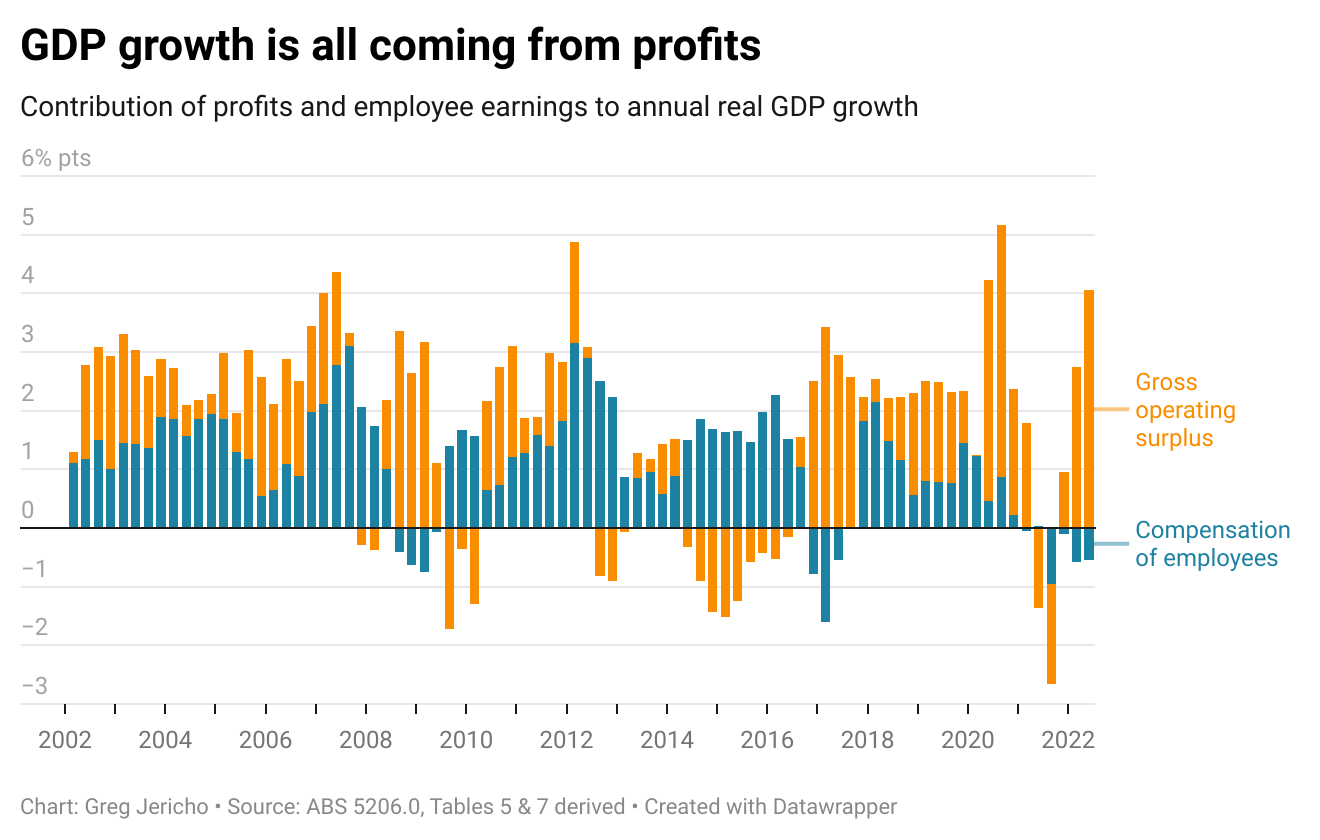
    But as labour market and fiscal policy director Greg Jericho notes in the Guardian Australia column, beneath those good numbers are a lot of problems, not the least of which is that wages continue to fail to keep up with inflation. Over the past year the total compensation of employees rose 7% but inflation in the national accounts rose 8.3%. Over the same period corporate profits went up 25%. We are at the absurd state of affairs where GDP is rising strongly, but real wages are not.

    We now have a situation where a record low share of national income is going to employees and a record high share is going to profits.

    The talk is always about lifting productivity and wages will follow, but the story for far too long now has really been productivity rising and profits following.

    The post The GDP figures show the ongoing shift of the national income to profits appeared first on The Australia Institute's Centre for Future Work.
  • The PBO reveals just how much the Stage 3 tax cuts favour the wealthy

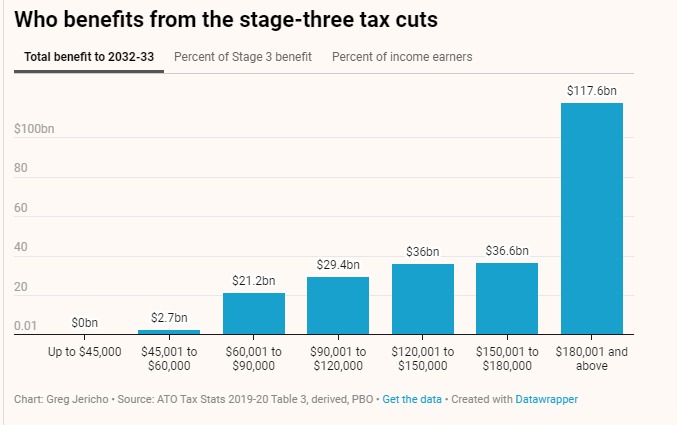
    As labour market and fiscal policy director, Greg Jericho notes in his Guardian Australia column, the PBO estimates that of the $243.5bn that the tax cuts will cost in their first 9 years, 48% will go to people earning over $180,000, and 77% will go to the richest 25%.

    In the first year of operation, the richest 1% of income earners will get the same benefit from the tax cuts as will the poorest 65%.

    Greg Jericho notes that in 2024-25, $12.7bn of the $17.7bn annual cost of the tax cuts that year will go to those earning above $120,000. That is almost the same amount expected to be spent on Jobseeker payments that year.

    The Stage 3 cuts are designed to favour the wealthy and reduce the level of revenue which in turn will force cuts to spending and programs that assist the most vulnerable.

    The post The PBO reveals just how much the Stage 3 tax cuts favour the wealthy appeared first on The Australia Institute's Centre for Future Work.
  • Market power costs consumers, workers and the whole economy

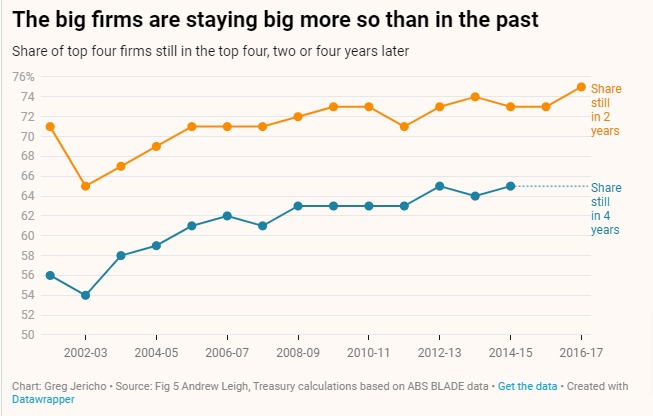
    But a speech by the assistant minister for competition, Andrew Leigh, reveals that businesses themselves and the way in which the major players are allowed to dominate industries is a significant drag on productivity growth.

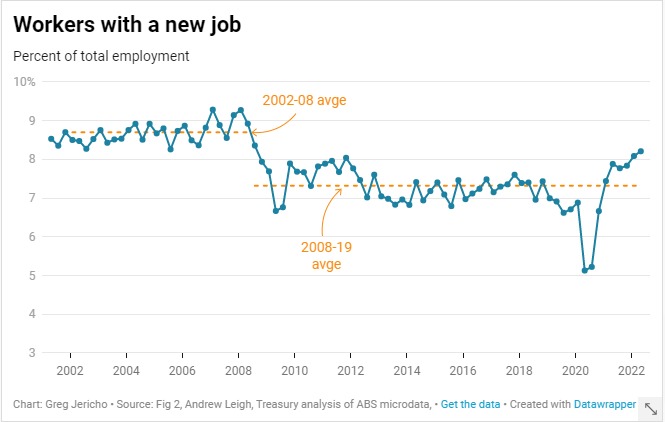
    In his Guardian Australia column, labour market and fiscal policy director Greg Jericho, reviews Dr Leigh’s speech and notes that over the past 20 years market concentration has increased across the whole economy. Over this time there has been a fall in the percent of new firms entering industries and also in established firms leaving. This produces a more sluggish economy where the need to innovate and pursue more productive operations is diminished. It also leads to firms being able to markup their prices by more each year as they consolidate their power, and also feel less need to offer better wages as the competition for labour falls.

    While wages growth crucially requires fair bargaining arrangements that enables workers to negotiate better wages, when workers have fewer options to pursue better paying jobs at other more productive workplaces, the number of workers switching jobs declines and so too does the market pressure to pay wages.

    Dr Leigh notes that this “decline in economic dynamism” needs greater policy focus, and his speech is an excellent corrective to the belief that improved productivity is all about taking away worker rights and giving more power to businesses to hire and fire.

    Australian business groups and many on the conservative side of politics love to talk up free-market competition, but the past 20 years has shown the markets are less about competition and more about concentration. And while profits have risen, workers and households have been left worse off.

    The post Market power costs consumers, workers and the whole economy appeared first on The Australia Institute's Centre for Future Work.
  • The biggest real wages fall on record

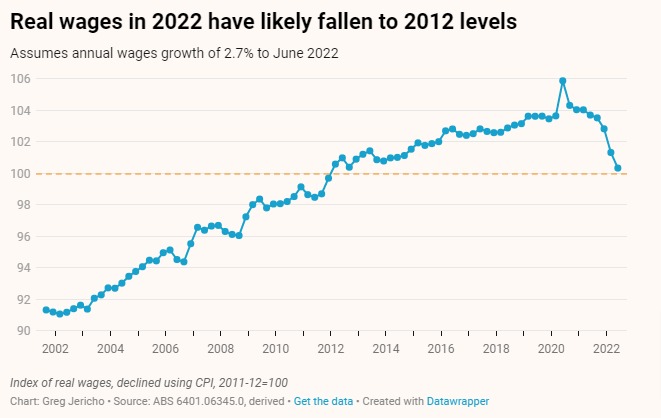
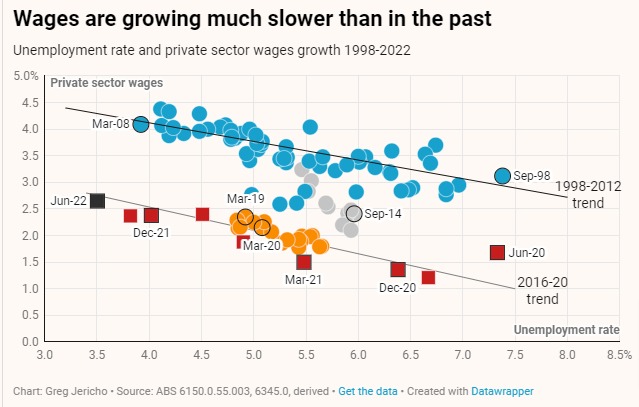
    In his column in Guardian Australia, Labour Market and Fiscal Policy Director, Greg Jericho, notes that while nominal wage grew 2.6% in the past year, real wages fell 3.3%. That fall has taken workers’ purchasing power back to 2012 levels.

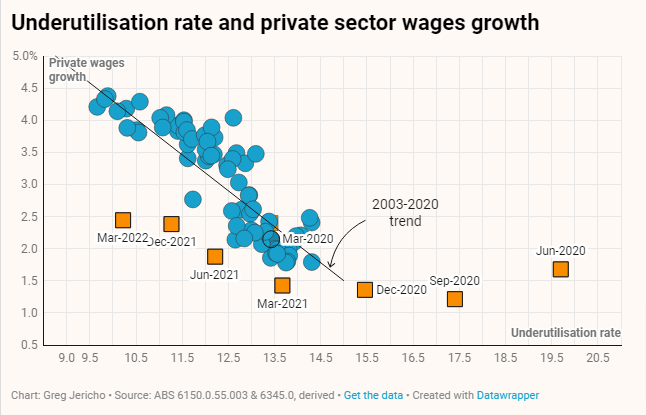
    This lack of strong wages growth despite unemployment being at nearly 50 year lows highlights just how skewed the bargaining system is against employees. In the past, unemployment this low would have been delivering wages well above 4%.

    The weak public-sector wages growth also reveals the impact of public-sector wage caps. For 6 consecutive quarters the annual growth of public-sector wages has been below that of the private sector. No longer does the public sector guide and support private-sector wages. This is the result of instituting arrangements which prevent a natural bargaining process to occur and in a time of rising inflation produce a massive fall in real wages for public-sector workers.

    In the past year wages in the education system, for example, rose just 2.3% on average, meaning teachers real wages fell 3.7% in the past year.

    While the real wages fall is terrible, it is likely worse for many families.

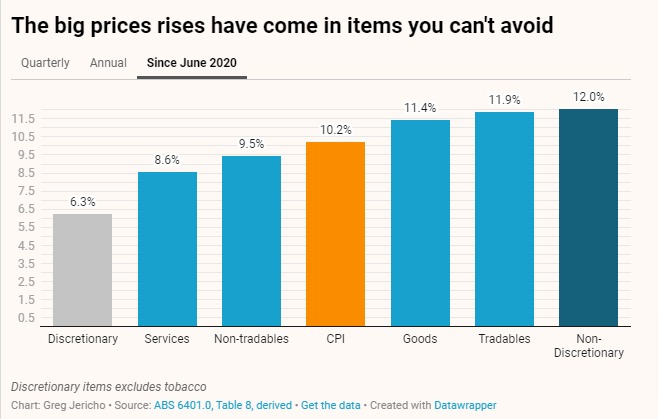
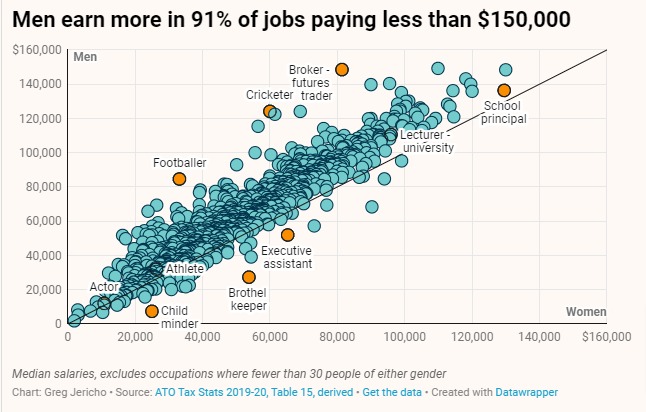
    The Bureau of Statistics estimates that households on average spend around 60% of their weekly expenses on essential/non-dictionary items. But because the prices of those items rose by 7.6% over the past year compared to average inflation of 6.1%, any households that need to spend a greater share of their income on essential items would have seen their real wages fall even further. For a family that spends 80% of their weekly budget on essential items, real wages fell by 4% – a truly horrific experience.

    The wages data confirm that there is no wages breakout that is driving inflation, instead workers are being left behind while companies produce record profits.

    The Jobs and Skills Summit in September must address this imbalance.

    The post The biggest real wages fall on record appeared first on The Australia Institute's Centre for Future Work.
  • The latest taxation statistics reveal the massive gender pay gap across the whole economy

    The 2019-20 taxation statistics released this week by the ATO provide a plethora of data that reveals with precision the salaries of people by location, occupation age and importantly, gender.

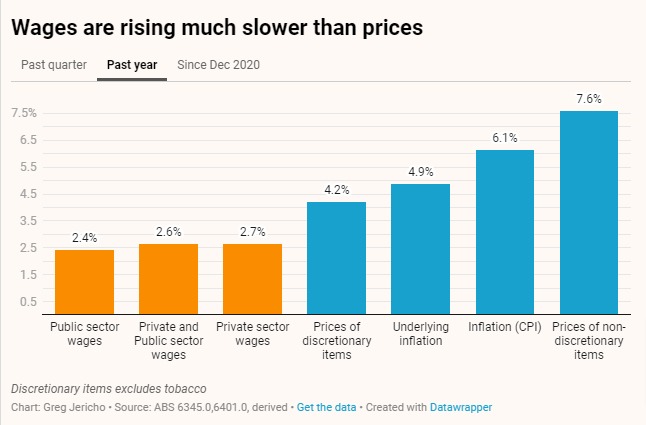
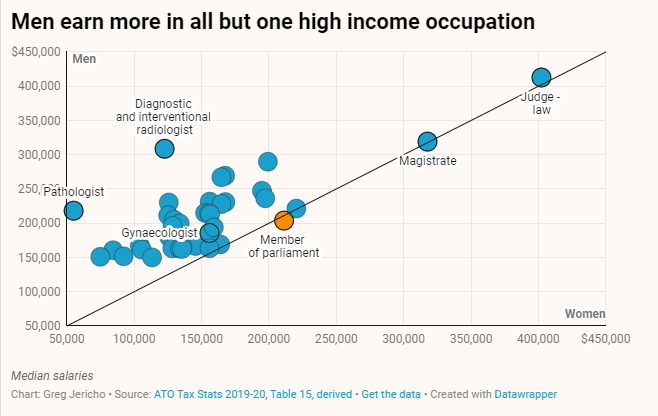
    Labour market and fiscal policy director, Greg Jericho, undertook a deep dive into the data. He notes in his column in Guardian Australia that in 91% of over 1,000 separate occupation groups from Nightclub DJ through to Magistrates and Judges, men have a higher median income than do women.

    The data reveals that women are less likely to work in higher paying occupations, and perhaps more damning those occupations with high levels of female participation are more likely to be low paid than are jobs which are mostly done by men.

    It is clear that work traditionally done by women is much lower paid than stereotypically traditional male jobs.

    But it is not just those occupations where the imbalance occurs. Even in jobs where women are the majority of workers, men will likely have a higher median salary and be more likely to be paid over $90,000 a year and be within the top two tax brackets.

    Women for example make up 57% of a journalists, and yet account for just 46% of all journalists earnings between $90,000 and $180,000 and a mere 36% of those earning above $180,000.

    The data highlights that the gender pay gap is not just about being paid the same hourly rate for the same work, but who gets the opportunity to work more hours, and who is more likely to be given roles that pay higher wages.

    It reveals a deep structural issue within our economy in which even in jobs largely done by women, the men in those occupations will most likely be paid more.

    The post The latest taxation statistics reveal the massive gender pay gap across the whole economy appeared first on The Australia Institute's Centre for Future Work.
  • Rate rises look set to dramatically slow the economy

    This is expected to have a dramatic impact on the economy with the Governor of the Reserve Bank announcing that the RBA expects GDP growth in 2023 and 2024 to be just 1.75%.

    Labour market and fiscal policy director, Greg Jericho, in his Guardian Australia column, notes that this would be the the first time since the 1990 recession that there have been 2 consecutive years of growth below 2%.

    The steep rise in rates, and the prospect of more to come suggests that the Reserve Bank’s efforts to curb inflation are likely to come at a high cost for workers.

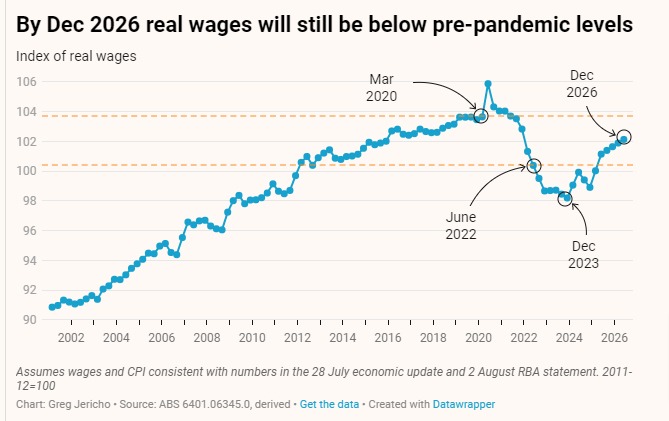
    The past year has seen the biggest fall in real wages since the introduction of the GST and current estimates from the Treasury and the Reserve Bank suggest further falls to come until the end of next year. By that point real wages would be more than 5% below pre-pandemic levels – a truly disastrous result in what is supposedly a recovery period.

    The post Rate rises look set to dramatically slow the economy appeared first on The Australia Institute's Centre for Future Work.
  • A decade of real wages growth lost as prices soar ahead of wages growth

    Given prices grew 6.1%, but wages are expected only to achieve around 2.7% growth in the 12 months to June, it remains abundantly clear that inflation is not being driven by labour costs. Indeed given real wages have likely fallen around 3.4% in the past year, wages are currently extremely deflationary.

    Real wages have now fallen for 8 consecutive quarters sending the purchasing power of employees back to 2012 levels.

    While the economy has rebounded and profits have risen strongly with that of prices, the “recovery” from the pandemic has very much been on the backs of workers who have effectively lost a decade’s worth of growth in real wages.

    Even worse, given the greatest price rises have occurred for essential commodities, it is clear low to median income workers are hurting much more than those who devote less of their spending on essentials than does the average household.

    All this is occurring with unemployment at near 50-year lows. It is now abundantly clear that the labour market systematically disempowers employees and needs to be reformed.

    The post A decade of real wages growth lost as prices soar ahead of wages growth appeared first on The Australia Institute's Centre for Future Work.
  • The Job Summit needs to produce a fairer labour market

    This has not happened by accident or some “invisible hand” of the free market. Decades of industrial relations legislation has purposefully reduced the ability for workers to organise and bargain for better wages.

    Labour market policy director, Greg Jericho writes in Guardian Australia that we are now also seeing for the first time a shift in the relationship between wages and underutilisation.

    These changes have meant that employees are receiving ever smaller slices of the national income pie.

    The past 24 years have also displayed that theory of increasing productivity resulting in better wages, works better in the economic textbook than reality. In just 7 of those 24 years, have real wages outgrown productivity – and 4 of those year were because of highly unusual cases of productivity actually declining.

    The Job Summit in September needs to be a time for a reset – a time to acknowledge that the labour market is not fairly weighted and that workers are not getting their fair share.

    The post The Job Summit needs to produce a fairer labour market appeared first on The Australia Institute's Centre for Future Work.