Author: Future Admin

  • Free Undergraduate Education to Save Universities and Jobs: Report

    The next federal government can save universities, make undergraduate education free for all Australians and employ tens of thousands of staff securely by lifting the public spend on higher education to just one per cent of GDP, according to a landmark new report.

    The Australia Institute’s Centre For Future Work report shows, if the federal government brings its annual investment in higher education into line with the OECD average, we could fix the destruction inflicted by the COVID pandemic and make universities more accessible and affordable for all Australians.

    Following decades of funding cuts, government inaction and the pandemic, more than 40,000 jobs were lost in public tertiary education in the 12 months to May 2021, 35,000 of those at public universities.

    National Tertiary Education Union (NTEU) National President Dr Alison Barnes said “Higher education needs to be made a priority in this election. The future of hundreds of thousands of staff and millions of students depends on it.

    “The state of the sector now is deeply concerning. It is the consequence of the Morrison Government’s decision to exclude universities from JobKeeper, hike student fees, cut funding per student place, entrench casualisation and decimate curiosity-driven research funding.

    “Thousands of jobs have been lost at public universities and the staff who are left are being kept on casual or short-term contracts. Those staff can’t plan for their future and often have their pay stolen by money-hungry universities who have built their business models on wage theft and insecure work.

    “The next Australian Government could remove the financial barrier to higher education, employ more than 26,000 staff in secure full-time jobs, restore research funding, reduce the over-reliance on casual staff and establish a new higher education agency to improve governance.

    “Free undergraduate education would be transformative for current and future students who are now facing more expensive degrees, mounting student debt and even the threat of being kicked off HECS if they don’t pass their courses.”

    Australia Institute economist and the report’s author Eliza Littleton said “As devastating as the pandemic has been for Australia’s universities, the sector was being distorted and damaged by corporatisation, casualisation, and privatisation long before COVID arrived.

    “Australia needs an ambitious national vision for higher education that re-aligns the sector with its public service mission, and with the needs of students, staff, and wider society.

    “Australia can choose a future for higher education that facilitates a stronger economy, social mobility and enhanced democracy – all the while generating a source of high-quality careers for many thousands of Australians.”

    The report’s recommendations include:

    • Free undergraduate education for Australian students
    • Adequate public funding for universities
    • Fully-funded research
    • Measures to ensure secure employment
    • Improved higher education governance
    • Caps on vice-chancellor salaries; and
    • Transparency in data collection.

    The post Free Undergraduate Education to Save Universities and Jobs: Report appeared first on The Australia Institute's Centre for Future Work.
  • Universal Public Early Child Education in Australia Would Pay For Itself: Research Report

    Making Early Child Education and Care (ECEC) universal in Australia would pay for itself by unlocking women’s labour supply, boosting GDP and growing government revenues by billions, according to new research from the Australia Institute’s Centre for Future Work.

    With cost of living shaping up as a key election issue, policy experts say boosted funding would ease the pressure on families, while boosting the economy.

    Key Findings:

    • ECEC funding is lower in Australia than other countries, yet private revenues (mostly paid by parents) are higher. Australian parents currently pay more but get less
    • Matching the ECEC funding levels of Nordic countries would generate 292,000 new jobs, directly, downstream and via increased women’s employment
    • If Australian women had the same participation and full-time employment rates as Nordic women Australia’s GDP would be some $132b per year higher
    • Government funding for public and non-profit childcare generates one-third more employment and GDP than funding for private for-profit firms
    • The economic activity supported by expanded funding for public and non-profit ECEC centres would boostAustralian GDP by a further $35b
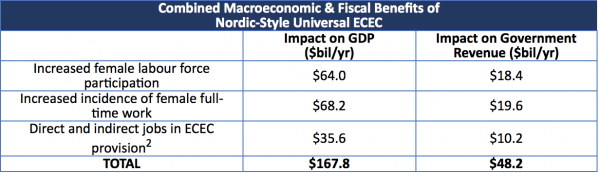
    • The combined boost to GDP would create an additional $48b in government revenue, more than the cost of providing the childcare services in the first place

    “This is a program that literally pays for itself,” said report author and Senior Economist at the Australia Institute, Matt Grudnoff.

    “This would create tens of billions of dollars in new GDP, hundreds of thousands of jobs and billions of dollars in government revenue – above and beyond the cost of providing those services in the first place.

    “A high-quality, accessible, and non-profit Early Child Education and Care system would facilitate the expanded paid work effort of hundreds of thousands of Australian women, helping close the gender pay gap.

    “At a moment when employers are complaining about a labour shortage, there is an obvious answer: support hundreds of thousands of women to increase their labour supply.

    “Expanded ECEC must be done right, to maximise the potential economic and social benefits. Funding must be directed to not-for-profit and public centres which put top priority on quality – not subsidising the profits of private investors who see children as a profit centre, not a social priority.

    “Childcare is a significant cost-of-living issue for many families with many spending more on childcare than groceries or utilities.

    “This is one of the smartest investments we could make for parents, for employment and for our society. It’s a no-brainer.”

    The report, The Economic Benefits of High-Quality Universal Early Child Education compared ECEC funding levels in Australia to other OECD countries.

    The below table summarises the combined impacts on GDP and tax revenues (for all levels of government) from the increase in labour force participation and full-time work by women, and the direct and indirect jobs associated with ECEC supply.

    The post Universal Public Early Child Education in Australia Would Pay For Itself: Research Report appeared first on The Australia Institute's Centre for Future Work.

  • Alison Pennington: Budget billions wasted as real wages go backwards

    The federal government’s budget would have us believe that the cost of living is a sudden problem because of higher oil prices.

    But the real reason people are feeling the pinch is because their real wages are going backwards.

    The budget forecasts wage growth of 2.75 per cent in 2021-22, below inflation which is forecast to grow by 4.25 per cent. That’s a real wage cut of 1.5 per cent.

    The budget will increase the low-and-middle-income tax offset, but then scrap it at the end of this financial year. The fuel excise will be reduced for six months.

    Complex tax-bracket-shifting schemes are a good way to distract from powerful wage suppression policies. While we’re calculating “how much do I get”, these policies entrench insecure work, cap public sector pay, and stop collective bargaining. These measures hit workers every pay packet, not just at tax time.

    The amount workers get from the tax cuts is nothing compared to normal wage increases. For the 15 years to 2012, private-sector wages grew about 3.5 per cent per year. For someone on $70,000, that’s about $2500 more in one year.

    Distracting the income-strapped

    This budget is about trying to distract the income-strapped with temporary solutions that do nothing to help in the long-run. Alongside time-bound tax cuts are $250 one-off payments to income support recipients – thousands of people who permanently languish below the poverty line.

    The government is also hoping people believe in magical free-market fairies – that lower unemployment will finally unlock wages growth. As though holding a job automatically equips workers with bargaining power.

    The “record funding” fairies were out in full force, too. The Treasurer says “record funding” has been allocated in schools, hospitals, mental health, aged care, women’s safety and disability health. But if you reduce spending to rock-bottom, every marginal increase in spending with population growth can be called “record funding”.

    If it’s not enough funding to meet demand, then it can still be “record funding” for some. Shockingly, public school funding will be cut by $560 million over the next three years. Meanwhile, JobKeeper-subsidy-dripping private schools will get $2.6 billion more over the forward estimates. It’s not a budget without blows.

    Cuts to workers’ pay

    Worse, this budget signals more cuts to workers’ pay. The budget has earmarked reducing legislated minimum redundancy payments for part-time workers. This will disproportionately affect women.

    Women’s chronically low wages and poor job quality receive no attention. Hundreds of thousands of women in underfunded healthcare and social services need government to front up and fund their pay increases. This budget is proof the biggest barrier to Australian women’s progress isn’t glass ceilings, but their own government.

    This government will balls up any opportunity to address structural gender inequality. A new paid parental leave (PPL) scheme will combine the paltry two-week Dad and Partner Pay with the existing 18-week program for a combined 20 weeks. Packaged as empowering “family choice”, it will remove any incentive for fathers to take leave.

    PPL payment at minimum wage will continue to push women into primary caring roles. This is because men earn almost one-third more than women on average. That’s not women’s “choice”.

    Governments have wage-booting tools to deal with the higher cost of living. Across the ditch, New Zealand just increased the minimum wage by 6 per cent, recognising its frontline lowest-paid workers have offered the most in the pandemic, and been hit the hardest.

    Genuine cost-of-living help overlooked

    Along with boosting minimum wages, there are other options for helping workers deal with high inflation. The government could lower the cost of living by ending fee-for-service practices in all the areas they fund – child care, aged care, and disability care. Under the current government, out-of-pocket healthcare costs have increased almost three times more than CPI.

    And there’s not much hope for youth in this budget. Presented with a future of declining living standards, political dysfunction and ecological catastrophe, young people are given just $206 million in mental health funding. They can talk to someone on the phone while the world burns.

    The bottom rungs on the economic-opportunity ladder have been eliminated and youth can’t get up. Tens of thousands of educated capable youth languish in dead-end jobs. Sacrificed by a government that would rather turn unemployment into a misery industry than to create secure, career-building jobs.

    Billions of waste

    The government is wasting billions of dollars paying off their friends in business without conditions to invest in higher wages. Before this Budget, $291 billion in public spending was ploughed into a “business-led recovery” from COVID. On businesses responsibility to reinvest post-war record-high profits, there’s an eery silence.

    And in this budget, we have zero assurances new business subsidies will be invested in the real economy – people, capital, research – rather than more profit-padding.

    On budget eve, Morrison attempted to hat-tip a bygone conservative era. He said “families” will be key to winning the upcoming election. But he never invested in them, instead putting them in a pressure cooker of record-low wage growth and high living costs.

    The government was struck by enormous luck this budget. Extra revenue to play with and they’ve thrown it all away. Hundreds of billions in government spending and no era-defining economic reforms.

    Cos-of-living pressures wouldn’t be as acute if people had almost a decade of normal wages growth. But the truth is, the government has pursued wage suppression over the entire nine years it has been in power.

    The post Alison Pennington: Budget billions wasted as real wages go backwards appeared first on The Australia Institute's Centre for Future Work.

  • New Research: Australia’s Skills System Continues to Crumble After COVID

    Australia’s vocational education and training (VET) system shows growing signs of erosion, fragmentation and dysfunction, according to new research from the Australia Institute’s Centre for Future Work.

    The research reveals a grim picture of a VET system starved of consistent funding or focus, fragmenting into scattered offerings of non-accredited and ‘micro-credential’ courses, mostly provided by private for-profit training companies. Furthermore, several high-profile government announcements during the pandemic designed to address skilled labour shortages have not altered the VET system’s worrying trajectory.

    Key findings:

    • The report recommends a stronger focus on a more pro-active, hands-on approach to workforce training and planning.
    • A new approach to training would support training in comprehensive, quality, accredited qualifications, rather than short-term fragments of training, with revitalised TAFE institutes leading the nation’s skills reconstruction process.
    • The report proposes that a minimum 70% of public VET funding be reallocated through the TAFE system.
    • New supports announced during COVID boosted government VET funding by $1.6 billion in 2019-20 from its five-year low. However deep and long-standing problems with Australia’s VET system have not been resolved – and in some cases, worsened.
    • All VET enrolment growth between 2015-20 has been in non-accredited training, growing by almost 70,000 enrolments, while properly regulated, accredited program enrolments have plunged by over 500,000.
    • Apprenticeship numbers showed a partial rebound in 2020-21 after eight years of marked decline – but Australia still has 173,000 fewer apprentices and trainees in training than it had in 2012, one-third below 2012 levels.
    • Empirical evidence shows rising apprenticeships ‘on the books’ are not being matched by any rise in completions. The number of apprenticeship and traineeship completions collapsed to a new low in the year ending June 2021, with just 77,000 completions – down almost two-thirds from 2013.
    • Government wage subsidies are creating strong incentives for employers to recycle heavily subsidised short-term apprentices. No requirements on employers to ensure apprentices finish programs, offer jobs after completion, and lower 5-10% subsidy rates under the government’s companion program Completing Apprenticeships combine to reinforce apprentice ‘churn’.
    • Three key feminised sectors facing huge shortages of qualified labour (nursing, education, and welfare programs) have all seen continued decline in numbers of apprentices.
    • Three in five (60%) new apprentices in-training over the year to June 2021 were men.
    • In 2021, the proportion of government-subsidised students studying with TAFE fell to less than half of all government-funded VET students (49%) – an historic low. 33% were attending for-profit private providers.
    • TAFE staffing and funding have also eroded further, as federal VET subsidies are diverted in favour of private for-profit providers. Failed market-based policies and TAFE defunding has seen over 8,800 full-time equivalent TAFE positions cut since 2012 across five states and territories.
    • Without renewed investment in TAFE programs, the significant annual economic benefits generated by the stock of TAFE-trained skilled workers in the labour force estimated at $92.5 billion per year will decay

    “Continued decline in enrolments and eight years of declining apprenticeship completions make it very clear: Australia’s domestic skills pipeline is in disarray,” said Alison Pennington, senior economist at the Australia Institute’s Centre for Future Work.

    “Deep failures in VET policy reflect broader failures of Australian economic policy to encourage far-sighted investments of any kind in the economy: physical capital, innovation, or skills.

    “Government COVID-era skills policies throw money at employers taking on apprentices and trainees, but have failed to fix the training system. There is no evidence the skills pipeline has been either protected or replenished under current VET policies.

    “Feminised industries with the most pressing labour shortages continue to see weak participation in accredited programs, traineeships, and apprenticeships. 3 in 5 of the additional apprentices and trainees in training over the year to June 2021 were men.

    “Once again, women’s jobs and demands have been deprioritised in favour of the optics of high-vis photo-ops.

    “Australia must commit to rebuilding the TAFE system’s leading role in reliable vocational education – the national skills policy infrastructure that can restore Australia’s long-term investment vision in its people, skills, and innovative sustainable industries.”

    The post New Research: Australia’s Skills System Continues to Crumble After COVID appeared first on The Australia Institute's Centre for Future Work.

  • International Collective Bargaining Experts Explore Future System Reform

    On 10 February, Centre for Future Work hosted an exciting timely panel discussion between international collective bargaining experts titled “Beyond the Enterprise: Building Sectoral Collective Bargaining Systems in the Anglophone World”. The panel, delivered for the Association of Industrial Relations Academics of Australia and New Zealand (AIRAANZ) 2022 Conference, explored proposals across Australia, New Zealand, Britain and the US for widening bargaining scope to the multi-employer, industry-wide, or occupational level. Panelists and their presentation links are below:

    • David Madland, Senior Fellow with Center for American Progress and Senior Adviser for the American Worker Project presented on lessons from the US and Britain on strengthening unions and broad-based bargaining proposals. There is a summary of David’s presentation available here.
    • Craig Renney, Director of Policy and Economist with the New Zealand Council of Trade Unions presented on NZ’s ambitious plan to implement sectoral bargaining through Fair Pay Agreements. Craig explained how FPAs can be initiated, bargained and agreed upon. Slides for Craig’s presentation are attached below.
    • Alison Pennington, Senior Economist with Centre for Future Work presented a new sectoral bargaining system design for Australia. The dual-tiered model proposed combines both a revitalised Awards system and multi-employer bargaining. Alison proposed traditional bargaining be re-integrated into Awards, with coverage, scope and minimum wage rates redrawn and refreshed. Her presentation is attached below.
    • Emma Cannen, Nation Research Coordinator with the United Workers Union presented on the bargaining challenges experienced in Australia’s highly fragmented, insecure, feminised care services, and why sector bargaining with stronger regulation and accountability is needed. Emma’s presentation can be viewed below.

    Jim Stanford, Economist and Director at Centre for Future Work chaired the panel.

    The AIRAANZ panel follows release of the 13-article Special Issue Global Lessons for Stronger Collective Bargaining Systems prepared by academic researchers and trade unionists from five countries for the peer-reviewed journal Labour and Industry. The Issue co-edited by Alison Pennington and Jim Stanford adopts a multi-dimensional approach to collective bargaining revitalisation, investigating the role of bargaining in skills and education, unemployment insurance and other social insurance policies, and industry policy – in addition to specific industrial relations matters.

    The final published versions of all articles in the Special Issue are available through Labour and Industry, or through your local library. All commentaries in the Issue freely accessible until end-March 2022.

    The post International Collective Bargaining Experts Explore Future System Reform appeared first on The Australia Institute's Centre for Future Work.

  • Australia ready to become sustainable EV-making powerhouse: new research

    The new report, Rebuilding Vehicle Manufacturing in Australia: Industrial Opportunities in an Electrified Future, has found Australia is uniquely blessed with advantages to attract and retain EV manufacturing and rebuild the nation’s car-making capacity. This potential, however, will not be met without major government action.

    “When it comes to creating an EV manufacturing sector, Australia enjoys advantages other nations would die for: rich reserves of lithium and rare earths, strong industrial infrastructure, a highly skilled workforce, powerful training capacity, abundant renewable energy options, and untapped consumer potential,” said Dr Mark Dean, the report’s lead author.

    “And contrary to popular belief, we wouldn’t be starting from scratch. Thanks to the resilience of our remaining automotive manufacturing supply chain, a surprising amount of auto manufacturing work – including components, specialty vehicles, and engineering – still exists here.”

    But Dr Dean said his research found Australia’s advantages would count for little without significant government support. The report makes a number of recommendations including:

    • Establishing an EV Manufacturing Industry Commission
    • Using tax incentives to encourage firms involved in the extraction of key minerals – primarily lithium and rare earths – with local manufacturing capabilities, especially emerging Australian EV battery industries
    • Introducing a long-term strategy for vocational training, ensuring the establishment of skills to service major EV manufacturers looking to set up operations Australia
    • Offering major global manufacturers incentives (tax incentives, access to infrastructure, potential public capital participation, etc) to global manufacturers to set up – especially in Australian regions undergoing transition from carbon-intensive industries
    • Introducing local procurement laws for the rapid electrification of government vehicle fleets

    “No nation builds a major industry without its government taking a proactive role. Our new research shows there’s no excuse for inaction, because there are a huge range of powerful levers our government could be pulling,” Dr Dean said.

    “If we capture the moment we’ll capture abundant benefits: creating tens of thousands of regional manufacturing jobs, reducing our dependence on raw resource extraction, reinforcing our accelerating transition toward non-polluting energy sources, and spurring innovation, research, and engineering activity in Australia. We just need our government to act.”

    The post Australia ready to become sustainable EV-making powerhouse: new research appeared first on The Australia Institute's Centre for Future Work.

  • As collective bargaining erodes in Australia, solutions from other countries could strengthen bargaining and lift wages

    On the heels of new data showing further erosion of Australia’s collective bargaining system, researchers and practitioners from five countries have identified best practices from other countries that could strengthen collective bargaining and lift wages.

    Key findings of the research include:

    • The Ardern government in New Zealand has implemented a new sector-wide bargaining system (called ‘Fair Pay Agreements’) that could be a model for similar changes in Australia. It would enhance workers’ ability to win more stable jobs and higher wages in highly fragmented industries (like security, cleaning or childcare).
    • New Zealand-style reforms could also improve the effectiveness of Australia’s pay equity legislation. Recent changes in New Zealand’s pay equity system prove that wider scope for bargaining can address persistent gendered pay discrimination. One recent enterprise agreement in Australia (covering public sector workers in Victoria) has already applies that model here.
    • Nordic and continental European countries have used coordinated sectoral bargaining systems to enhance vocational training and technology adoption. Australia could learn from that experience to better integrate skills programs with secure job pathways.
    • In Germany, a combination of sector-wide bargaining over wages and other core compensation, combined with workplace-level consultations (under that country’s ‘works council’ system), produces employment outcomes that are both flexible and fair.

    “The erosion of collective bargaining has been a major factor in Australia’s record-weak wage growth over the past decade,” said Alison Pennington, Senior Economist at the Centre for Future Work and co-editor (with Dr. Jim Stanford) of the special issue.

    “This research confirms that other countries are implementing innovative and powerful measures to strengthen collective bargaining and support a healthier post-COVID recovery. Australia should learn from those countries and take urgent measures to stop the decline of collective bargaining here.”

    “A wealth of experience from other countries proves collective bargaining can be strengthened and modernised, to provide workers with a decent shot at fair compensation and better jobs. Unfortunately, Australian governments seem more obsessed with vilifying and policing unions, instead of engaging them as full and constructive partners. The resulting erosion of collective bargaining will only lead to even weaker wages in the future,” said Pennington.

    New data released this week from the Commonwealth government confirm that collective bargaining coverage has declined further during the pandemic, with 600,000 workers losing enterprise agreement coverage since end-2019. That erosion of collective bargaining has been a key reason for Australia’s record-weak wage growth.

    The newly released special issue of Labour and Industry contains 13 contributions from academics, union leaders, and practitioners around the world.

    “Australian workers need an effective system of collective bargaining that goes beyond the legal entity that directly employs them,” said Tim Kennedy, Secretary of the United Workers Union, and co-author one of the articles in the special issue. “This is a vital mechanism to ensure workers have greater control over the safety of their work, across sectors, industries, franchises, labour hire arrangements, supply chains – or however work is configured.”

    “Australia is currently deprived of the skill formation benefits that arise from strong sectoral collective bargaining between social partners in Nordic nations,” said Andrew Scott, Professor of Politics and Policy at Deakin University, and author of another article in the special issue.

    “It’s exacerbating deficiencies in our training arrangements, evident in high rates of misalignment between jobs and skills. Australia can learn much from the Nordic countries’ superior economic and social policy outcomes that arise from well-integrated skills and collective bargaining systems,” said Professor Scott.

    The research is the culmination of a two-year project coordinated by the Centre for Future Work at the Australia Institute.

    The post As collective bargaining erodes in Australia, solutions from other countries could strengthen bargaining and lift wages appeared first on The Australia Institute's Centre for Future Work.

  • Victorian Rate Cap Policy Costs Economy Over 7,000 jobs and $890 million to GDP

    The Victorian State Government’s policy to cap the rates of local government has cost the Victorian economy 7,425 direct and indirect jobs in 2021-22, and has reduced GDP by up to $890 million in 2021-22, according to new research from the Australia Institute’s Centre for Future Work.

    Key Findings

    • The Victorian Government’s rate caps have reduced employment in Victoria (counting both direct local government jobs, and indirect private sector positions) by up to 7425 jobs in 2021-22. They have also reduced GDP by up to $890 million in 2021-22. The costs of suppressed local government revenues, and corresponding austerity in the delivery of local government services, will continue to grow with each passing year if the policy is maintained.
    • Rates on property are the largest single source of revenue to local governments in Victoria. Of total Victorian local government revenue in 2019-20 ($11.7 billion), rates accounted for $5.6 billion or almost half. Since 2016-17, the Victorian state government has capped the amounts local governments can collect from their ratepayers.
    • The rate cap policy, imposed by the Victorian state government on local governments, interferes with the mission of service delivery and expanded, secure employment.
    • The local government sector in Victoria employs about 50,000 people in a wide range of services and occupations, including road planning and maintenance, home and aged care, waste disposal, libraries, childcare, school crossing supervision, maternal and child health, the State Emergency Service, and environmental management.
    • The rate cap policy becomes more restrictive as the overall economy slows rather than less restrictive, since the rate cap is tied to inflation indexes which tend to slow when the economy is weak.
    • The rate caps act as a brake on recovery and growth by embedding a dynamic of self-fulfilling fiscal restraint and austerity.
    • Victoria’s rate cap policy has inhibited a normal trend of expanding and improving local government services in line with population growth, rising living standards, and economic expansion.

    “Rate caps are an arbitrary policy which ties growth in overall rates revenue to price indexes which have nothing to do with demand for services or democratic accountability,” said Dan Nahum, economist at the Australia Institute’s Centre for Future Work.

    “It’s not even the case that ratepayers necessarily save any money as a result of the rate cap. There has been a shift to other forms of revenue-raising that are less progressive and socially equitable.

    “Rates bills are calculated based on relative property valuations – so even if local governments are collecting less from rates overall than they would in the absence of the cap, if your property value has gone up relative to others in your community, then your rates payments do as well.

    “There is no evidence that rate caps makes local councils ‘more efficient’. Instead, it simply takes money out of much-needed council services and robs local communities of employment opportunities.

    “Far from protecting ratepayers and residents, rate caps hurt them. Rate caps compromise service delivery, negatively impact employment and wages amongst residents employed in the local government sector, result in higher fees collected through other revenue tools, and reduce local government expenditures flowing back into the private sector.

    “There is simply no good economic reason for rate caps. By abolishing the rate caps policy, the Victorian Government could create jobs and stimulate the economy post-COVID.”

    The post Victorian Rate Cap Policy Costs Economy Over 7,000 jobs and $890 million to GDP appeared first on The Australia Institute's Centre for Future Work.

  • The great (gendered) resignation is not what you think. It’s worse

    Have you heard? The so-called great resignation is afoot. A world where an empowered workforce say “no” to bad bosses and a life dictated by work. In the US, increased job departures have been coined a “revolution in workers’ expectations”.

    Australian workers were squeezed for an average 6.1 hours unpaid overtime per week in 2021 – a substantial increase on 2020. If only expectations matched reality.

    In Australia, employers crow about shortages in low-paid, “churn and burn” jobs of which they refuse to improve the quality. Meanwhile, 700,000 people are unemployed, and 1.3 million are in jobs, but need more work. Around 1 million more aren’t looking for work, but want to work and are available. The ABS calls them “marginally attached” and “discouraged” workers.

    Women know a thing or two about being discouraged. Far from quitting as an act of righteous agency, they’ve lost their jobs during lockdowns against their will. It’s material. Less “life’s too short to work 24/7”. More “my kids need care immediately”.

    The explosion in caring demands associated with lockdowns fell disproportionately to women – as in 2020, when women’s average hours caring for children and performing household tasks rose faster than for men, reaching 5.1 hours per day (versus 3.1 for men).

    In February 2021, 175,000 women didn’t look for work even though they were available and ready to start within four weeks because they had pressing caring responsibilities.

    Even if women loaded with caring demands wanted to retain their jobs, the odds were stacked against them. They hold the majority of low-hours insecure jobs without protections against sacking. When bosses want to shed jobs to save bottom lines, women cop it worst.

    68% of all jobs lost between May and October were held by women (205,000 jobs). Women’s participation in the job market fell 1.7 percentage points. Nearly all (90%) of women’s jobs lost were part-time.

    Little acknowledged, the latest job vacancies data mirror women’s exodus from paid work. In August, vacancies were highest in healthcare, administration and retail. These are all industries employing 50% or more women. All are in the bottom-half of industries by average weekly earnings.

    The question is, as wallets open, beers flow and economic activity resumes, what’s bringing women back to work? A couple shifts at minimum wage, and higher COVID-19 contagion risks to boot. All to pay for one day of high-cost childcare? Hardly appealing.

    An empowered workforce can walk away from bad jobs. But structural barriers stop women from participating in the first place.

    High-cost childcare is a clear barrier for women workers. Before the pandemic, over half of non-employed women with young children said high-cost childcare was the biggest influence on their decision not to work.

    Australia’s outdated paid parental scheme bakes “primary” and “secondary” carers into family structures – reinforcing the exodus of women from work, and blocking the equal participation of fathers in raising their children.

    The so-called great resignation is gendered. But women shouldn’t have to resign themselves to the revolving door of crap jobs and important caring responsibilities.

    We’ve come a long way since the 1950s when conservative norms dictated women’s labour should be unpaid and confined to the home. Women have better access to the world of paid work now. But their relegation to insecure, low-paid, and junior roles shows we have much further to go.

    And it’s government policies that holds us back.

    Australian women need genuine measures to support them in all aspects of their lives; from free early childhood care and education, better work-family balance policies, pay equity, and more opportunities for decent jobs.

    Only then, can women imagine a world where they are empowered through work.

    The post The great (gendered) resignation is not what you think. It’s worse appeared first on The Australia Institute's Centre for Future Work.

  • Eight free weeks: Time stolen from employees skyrockets during COVID

    The number of hours stolen from Australians by employers has skyrocketed during the COVID-19 pandemic, with the average employee now providing eight full-time weeks of free work per year.

    17 November 2021 marks Go Home on Time Day, run by the Australia Institute’s Centre for Future Work, and now in its thirteenth year.

    Key findings from this year’s Go Home on Time Day report:

    • The average employed Australian is performing 6.13 hours of unpaid work each week in 2021, up from 5.25 in 2020, and 4.62 in 2019.
    • That time theft equates to 319 hours per year, or over eight standard 38-hour work weeks per worker.
    • This unpaid overtime represents the loss of $125 billion in income from Australian workers in the past year, or $461.60 per worker every fortnight.
    • COVID-19 appears to have accelerated Australia’s time theft crisis, with 26% of workers reporting their employers’ expectations of their availability increased during the pandemic.
    • Amidst the growth in working from home during COVID, employers are using new technologies to pressure and monitor employees. 39% of workers report their employers are remotely monitoring them through technology like webcams and keystroke counters.
    • Young workers aged 18-29 performed the most unpaid overtime (8.17 hours per week)

    “This year Australian workers are taking home a smaller share of GDP than we have ever seen before. Yet, time-theft is rife and bosses are stealing record amounts of unpaid time from workers,” said Dan Nahum, economist at the Australia Institute’s Centre for Future Work.

    “Arriving at work early, staying late, working through breaks, working nights and weekends, taking calls or emails out of hours – there are a host of ways employers steal time from their employees, and we see them all being used prodigiously.

    “COVID-19 has made the situation worse, indicating work-from-home does not necessarily improve work life in favour of employees. Instead we’re seeing further incursion of work into people’s personal time and their privacy. In many cases it’s making it easier for employers to undercut Australian minimum standards around hours, overtime, and penalty rates.

    “Alarmingly work-from-home arrangements have been accompanied by innovative surveillance methods, with 39 per cent of employees saying their employers remotely monitor their activity and a further 17 per cent unsure whether they were being electronically monitored or not. When one in three workers say they are being monitored via webcam and 30 per cent say their every keystroke is being recorded, it’s clear our industrial laws are not keeping pace with tech.

    “If Australians want to stop this alarming theft of billions of hours of time, and hundreds of billions of dollars of income, policymakers need to strengthen workers’ power to demand reasonable, stable hours of limit, and fair payment for every hour they work. This is all the more important with so many Australians working from their own homes.”

    Mr Nahum said it was an injustice that many Australians report being eager for more paid hours while contributing free ones to their boss.

    “Half the part-time and casual workers in this country report they are keen for more paid hours, yet the average part-timer is giving away over 4.5 hours a week and the average casual just over 5 hours,” Mr Nahum said.

    “These are worker efforts that should end up as wages in someone’s pocket, not a boost to a profit column.”

    The post Eight free weeks: Time stolen from employees skyrockets during COVID appeared first on The Australia Institute's Centre for Future Work.