Author: Future Admin

  • Interest Rate Hikes Will Hurt Workers to Protect Profits

    In this commentary, Centre for Future Work Associate Dr Anis Chowdhury challenges the wisdom of this strategy. Since current inflation is related more to supply chain disruptions and other global pressures, higher interest rates will do more harm than good – and shift national income even further toward the owners of capital, instead of working Australians.

    Interest Rates Hikes Will Hurt Workers to Protect Profits

    by Dr Anis Chowdhury

    The Reserve Bank’s latest interest rate hike, the fourth in a series and with more to come, will certainly slow economic activity and raise unemployment. It will hurt families, especially of the working class, who played no role in the current bout of inflation.

    Treasurer Jim Chalmers warned Parliament, “Families will now have to make more hard decisions about how to balance the household budget in the face of other pressures like higher grocery prices, and higher car prices and the cost of other essentials”.

    This is bad news, especially since many will also lose their jobs as the economy slows.

    But it didn’t have to be like this – had the RBA and other policy-makers cared to seriously consider what is driving inflation, and been less dogmatic about their inflation target and how to reach it. Many seem to have forgotten the Labor Government’s own successful experience of addressing inflation in the 1980s through social dialogue, reducing price pressures without causing unemployment to rise. Those lessons should be relearned today.

    What is driving current price rises?

    The primary source of current price pressure is not surging demand, soaring wages, or a household spending spree fueled by pent-up demand and one-off pandemic financial supports. Indeed, as RBA Governor Philip Lowe has acknowledged, “The household saving rate remains higher than it was before the pandemic and many households have built up large financial buffers”.

    Even the labour market tightening and skills shortages seen in some sectors are not the result of surging aggregate demand, but rather mostly due to the impacts of the pandemic on labour supply (including via restrictions on the inflow of migrant workers).

    Instead, the primary driver of current inflation is supply bottlenecks and blockages of goods, caused by a perfect storm of global problems: the pandemic, the war in Ukraine, and climate change’s effect on agricultural supply (and hence prices of food).

    Interest rate hikes cannot fix supply bottlenecks; instead, they will exacerbate supply problems, by discouraging investment in new capacity and infrastructure. Interest rate hikes will also impose collateral damages on government finance, in addition to causing job losses and economic hardship for struggling families.

    The Treasurer’s warning to brace for bigger real wage cuts than previously flagged is no comfort for the ordinary workers who already saw their income share in GDP steadily decline during the past four decades – while the share of GDP going to capital owners in profits continued to rise, setting record highs during the pandemic.

    A recent report from the Australia Institute found that rising prices in Australia are actually driving corporations’ profits to record highs amid a cost-of-living crisis for the rest of us. This has been enabled in large part by lack of competition. Big corporations in energy, transportation, supermarkets, and other sectors use their oligopolistic power to raise prices (and profits) far above what would be necessary simply to cover higher input costs.

    A recent study published in the UNSW Law Journal documented widespread price gouging in Australia: “a notorious practice” involving “pricing high-demand essentials at levels significantly higher than what is commonly considered acceptable, reasonable or fair”. During recent crises, including the Black Summer bushfires and then the COVID pandemic, unethical businesses exploited public desperation for basic consumer goods and services, such as hygiene products, staple foods, and utility services, to raise their profit margins.

    Why raise interest rates?

    The RBA knows it cannot fix supply shortages. Yet still it raises the interest rate, calls it a “forward-looking” strategy, and claims it will stem inflationary expectations and higher wage demands. Basically, this is a tactic to scare workers: in essence, saying to workers they must not ask for compensating wage gains or for restoring their share of domestic income, lest the Bank inflict more pain through losing jobs and livelihoods.

    Central bankers around the world sugar-coat this scare tactic by saying, “It’s short-term pain for long-term gain”. That’s easy for them to say, as no central banker ever lost his/her job for such actions, or have tasted this “short-term pain” (which can actually affect a worker and their family for decades via lost work and suppressed incomes).

    This view also ignores the fact that labour’s bargaining power has significantly declined compared to previous inflationary episodes, due to the erosion of collective bargaining and other institutional supports for wages, new technology, out-sourcing and globalisation. All these factors have driven the steady declines in labour income share and real wages. They also mean that fears of a 1970s-style “wage-price spiral” are not credible.

    The interest rate: a blunt tool

    The dogmatic stance of central bankers will cause more damage than it avoids. Even when inflation is rising, higher interest rates are not the right policy tool to tackle the problem for several reasons.

    First, the interest rate only addresses symptoms, not the root causes, of inflation. Inflation is often understood as the overheating of an economy. Like a fever, overheating of an economy can be due to many causes – fever and overheating are just symptoms. Interest rates, like Panadols or Aspirins, may relieve the overheating, but the treatment requires investigations into the root causes and appropriate medications.

    Second, changes in the interest rate affect all sectors – without distinguishing sectors that need expansion and hence credit support, from sectors that are less productive or inefficient and hence should be credit-constrained. Just as taking too many Panadols or Aspirins can have fatal side effects, hiking interest rates too often and too high can kill productive and efficient businesses along with less productive and inefficient ones.

    Third, the overall interest rate does not distinguish between households and businesses. Higher interest rates may encourage households to save, but will dampen business capital spending. Thus, overall economy-wide demand will shrink, discouraging investment in new technology, plant and equipment as well as skill-upgrading. Thus, higher interest rates adversely affect the long-term productive capacity of an economy.

    Fourth, higher interest rates will raise the debt burden for governments, business and households. Global debt burdens have been on the rise since the 2008-2009 global financial crises, and even more dramatically during the COVID crisis. Those debts (especially sovereign government debts) are manageable so long as economic growth remains robust and interest rates low. Current monetary policy, however, will negatively affect both factors: raising rates and slowing growth. That could set the stage for debt problems down the road.

    Monetary tightening will have implications for fiscal policy, too. A slower economy implies less tax revenues and more social security payments. Government is already under pressure to continue pandemic support measures, such as financial assistance for workers without paid sick leave as well as cost-of-living supports. Planned Stage Three tax cuts, if they go ahead, would further undermine Commonwealth government revenues. For state governments, heavily reliant on stamp duties, a collapse of the housing market would devastate their budget bottom-lines.

    Paradoxically, higher interest rates can even feed into higher costs of living, as indebted households’ debt-servicing costs (especially on mortgages) rise. The cost of living would also rise if businesses with market power pass on their own higher interest costs to consumers through still higher prices.

    Policy innovation

    As mentioned earlier, the current inflationary surge is due to supply shortages of key products, such as food and fuel. Therefore, the long-term solution requires expansion of supply and removal of bottlenecks. Perversely, however, higher interest rates force overall demand to shrink down to match aggregate supply. That can slow price increases, but leaves underlying supply constraints for key products unaddressed – hence not addressing the underlying causes of inflation.

    Therefore, policymakers should consider innovative and more appropriate policy tools to respond to current price pressures. The focus of anti-inflationary policy should be changed radically from suppressing domestic demand to enhancing supply and productivity; from restricting credit indiscriminately to easing financing constraints for key and ‘sun-rise’ industries (e.g., renewable energy) while tightening financial conditions for inefficient (e.g., polluting) and speculative activities (e.g., real estate).

    This would mean designing macroeconomic policies to support industrialisation and economic diversification. Instead of reacting to inflationary symptoms with a lone blunt policy tool (the interest rate), policymakers should wield a mix of fiscal and monetary policy levers: using them to unlock supply bottlenecks, enhance productivity, and encourage savings and productive investments (especially to decarbonise the economy).

    Each of these goals needs innovative and customised policy tools, rather than a one-size-fits-all reliance on interest rates to throw cold water over the entire economy.

    Social partnership

    Inflation and responses to it inevitably involve social conflicts over economic distribution. The ‘social dialogue’ approach of Labor Prime Minister Bob Hawke contrasted with the more confrontational approaches of Margaret Thatcher and Ronald Reagan – and their deliberate use of punishing interest rates to inflict long recessions in the 1980s.

    In contrast, social dialogue in Australia not only brought down inflation and unemployment simultaneously in the 1980s, but also enabled difficult reforms – including floating exchange rates and lower import tariffs. That set the stage for sustained economic growth in years to come.

    The new Labor Government needs to earnestly begin rebuilding that model of social partnership to confront not only current inflation challenges, but the more existential threats of climate change and shifts in the global order.

    The government must also not miss the opportunity to review the RBA’s mandate and operations, including better balancing its board with a more representative variety of stakeholders (including workers). The economy does not work in a vacuum, and should not be entrusted to technocrats. Policies and reforms affect real lives and livelihoods. The RBA needs to understand, and hear, the voices and preferences of all Australians, not just financiers and employers.

    The post Interest Rate Hikes Will Hurt Workers to Protect Profits appeared first on The Australia Institute's Centre for Future Work.
  • Exit Poll: Overwhelming Majority of Australians Want Wage Growth in Line with Cost of Living

    As the Fair Work Commission prepares to announce this year’s increase in the national minimum wage, new polling data shows that the vast majority of Australians support lifting wages to keep up with rising inflation.

    The Australia Institute conducted a special exit poll, surveying a nationally representative sample of 1,424 Australians on the evening of Saturday May 21, following the federal election. Among other questions, the survey asked about voters’ attitudes towards cost of living and low wage growth.

    Key Findings:

    • An overwhelming majority of Australians (83%) support wage increases that keep up with cost of living, only 10% disagree.
      • Strong support for boosting wages to keep up with inflation was expressed across all voting intentions (Coalition 79% agree, 13% disagree; Labor 88% agree, 8% disagree; Greens 83% agree, 11% disagree; PHON 70% agree, 14% disagree; IND/other 84% agree, 7% disagree.)
    • In this context, criticism directed at Mr. Albanese during the election campaign for agreeing that wage increases should keep pace with inflation more likely hurt the Coalition campaign, not the Labor leader.
      • 39% of respondents felt Labor was best placed to address the issues of wages and the cost of living, compared to 26% who felt the Coalition had the stronger position.
    • Almost two in three Australians (65%) believe their nominal incomes have lagged behind inflation in the past year.
      • Regarding what can be done to ameliorate this problem, Australians were evenly divided: about half of respondents believe government policies can significantly alter the course of wage growth, while the other half do not.

    “Our research shows that while conservative commentators might be alarmed at the idea that wages should increase as fast as prices, among the voting public the idea seems reasonable and fair,” said Dr Jim Stanford, Economist and Director of the Centre for Future Work.

    “There is no economic basis for the view that wages keeping up with inflation will only cause further inflation. The current cost of living crisis is clearly due to factors (like supply chain disruptions and global energy prices) that have nothing to do with Australian wages.

    “Unit labour costs in Australia are falling, not increasing. Workers should not be punished further with falling real wages for a problem they did not create.

    “Wages can and should keep pace with rising prices to protect the real living standards of Australian workers, while the true causes of inflation are addressed.”

    The post Exit Poll: Overwhelming Majority of Australians Want Wage Growth in Line with Cost of Living appeared first on The Australia Institute's Centre for Future Work.

  • Enterprise Bargaining System no Longer Fit for Purpose

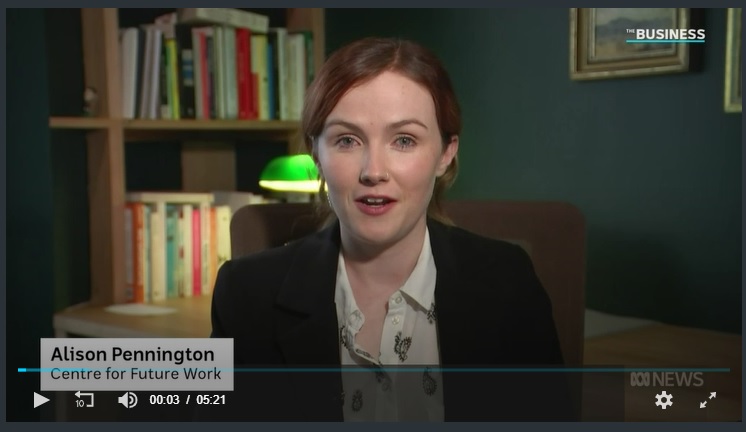
    The new Commonwealth government has pledged to find ways to strengthen collective bargaining. In this feature interview with the ABC’s national economics program The Business, Senior Economist Alison Pennington discusses the reasons why the current system is not working, and some of the reforms that will be required to support bargaining and lift wages.

    Alison Pennington on ABC

    The post Enterprise Bargaining System no Longer Fit for Purpose appeared first on The Australia Institute's Centre for Future Work.

  • Joseph E. Stiglitz Australian Speaking Tour: July 2022

    Nobel Laureate, former World Bank Chief Economist, and best-selling author Professor Joseph E. Stiglitz will visit Australia in July 2022 to discuss the need to expand the role of governments, unions, and civil society.

    The tour, hosted by the Australia Institute, will see Professor Stiglitz speak at a wide range of events for the general public, policymakers, unions, civil society, investors and philanthropists.

    “Professor Joseph Stiglitz is not only one of the world’s leading intellectuals and policy advisers, he has a unique ability to translate complex economic issues into language that both engages and informs, something essential for our democracy to flourish,” said Ben Oquist, executive director of the Australia Institute.

    “The Australia Institute is delighted to host such a guest at such an important time in Australia’s economic policy debates. The essential and expanding role for government in driving economic prosperity is too little discussed. We hope this tour can help address that deficit.”

    Professor Stiglitz will visit Sydney, Hobart, Canberra, and Melbourne in July 2022

    The post Joseph E. Stiglitz Australian Speaking Tour: July 2022 ‘The Role of Government in the Modern Economy’ appeared first on The Australia Institute's Centre for Future Work.

  • Unemployment Rate Does Not Tell the Whole Story

    In this commentary, CFW Associate Dr Anis Chowdhury explains why a lower unemployment rate, on its own, is not a solution to Australia’s labour market and social challenges.

    Don’t Be Fooled: A Lower Unemployment Rate is Not a Magic Bullet

    Two days before the federal election, comes news that Australia’s unemployment rate had slipped below 4% in March, to 3.9% – the lowest rate in 48 years.

    But this aggregate number hides some hard realities for struggling vulnerable people. For example, the youth unemployment rate increased to 8.8%. About 3 million Australian workers lack basic job security. That includes some 2.4 million workers in casual positions, with no paid leave entitlements. A further 500,000 are on fixed-term contracts. A survey by PwC found that anxiety about the economic future intensified due to the pandemic. Some 56% of Australians now believe few people will have stable, long-term employment in the future (more than two years).

    Meanwhile, the labour force participation rate decreased to 66.3% in March as workers continue to suffer from the pandemic’s scars – including mental health challenges and long COVID’s debilitating health issues. So this apparent labour market tightening is misleading: it is mainly due to this decline in the participation rate, as well as pandemic restrictions on migrant workers (including students and seasonal travellers) which have sharply constrained the size of Australia’s labour force.

    Most telling, Australia’s recent falling unemployment rate is having little effect on wages growth; wages grew 2.4% in the year to March, up only marginally on the 2.3% from the previous reading; and less than half the 5.1% rate of inflation.

    Rising interest rates will now deliver a further blow to the living conditions of ordinary citizens as they struggle to service their debts. With household debt equal to about 120% of annual GDP, Australian households are among the most indebted in the world. As the Reserve Bank is poised to raise interest rates further, Andrew McKellar of the Australian Chamber of Commerce has warned that Australians “have to be very careful”; interest rate hikes are “set to affect Australian businesses nationwide across a number of sectors”.

    So it’s not being alarmist to warn that a recession could be just around the corner: one that would see unemployment rising alongside inflation. The Reserve Bank has little control over the factors (mainly global supply chain disruptions, and rising food and fuel prices) that have led the current cost-of-living inflation. Past history suggests that central banks’ efforts to disinflate the economy produce slower growth, higher unemployment, and often recessions.

    Address the deeper malaises

    No matter who wins the current federal election, the incoming government will have to tackle deeper malaises in the Australian economy. They include stagnating productivity growth and the falling labour income share in GDP.

    Australia’s aggregate labour productivity growth (real output per hour) has stayed mainly in a band between 1.2 and 2.5% per year during the last 50 years; it fell to 0.2% during 2018-2019, but has rebounded since the pandemic (averaging 2% per year from end-2019 through end-2021). Productivity growth is a key source of long term economic and income growth, and as such, is an important determinant of a country’s average living standards. Productivity gains also drive down the cost of goods and services and enhance international competitiveness.

    The impact of productivity growth on standards of living has been undermined, however, by capital’s capture of productivity gains. Real wages have grown much more slowly than real labour productivity (and now, with surging inflation, real wages are falling rapidly). Thus, labour income’s share in Australia steadily declined from the peak of around 58.5% in the mid-1970s to a record low of 46% of GDP at end-2021, as the gap between productivity growth and real wage growth widened.

    Among many factors, wage-suppressing policies and increased job insecurity have contributed to this dismal outcome. More than half of Australian participants in the PwC survey (61%) felt the government should act to protect jobs, with that opinion more acute among 18-34 year-olds (63%) than those over 65 (50%).

    Both the Reserve Bank of Australia and Treasury have made clear, Australia’s low wage growth is a major drag on the economy. But low wage growth was not accidental; the former Coalition Finance Minister, Matthias Cormann, now OECD Secretary-General, described (downward) flexibility in the rate of wage growth as “a deliberate design feature of our economic architecture”.

    Looking after workers is good economic policy

    Coalition leaders attacked Labor leader Albanese’s support for raising the minimum wage, claiming without evidence that a big increase in the minimum wage might force some workplaces to close. The business lobbies also joined the chorus.

    But is this opposition to higher wages grounded in good economics? The available historical evidence, as well as theoretical considerations, say: “no”.

    Robert Bosch, the German industrialist, engineer and inventor, founder of Robert Bosch GmbH (electrical co), introduced 8-hour working days in 1906, free Saturdays in 1910, and other benefits for his workers. He said: “I don’t pay good wages because I have a lot of money; I have a lot of money because I pay good wages.”

    Henry Ford, the American industrialist, the founder of the Ford Motor Company, and developer of the assembly line, doubled the pay of his workers to $5 a day in 1914. In justifying his decision he said: “Of course the higher wage drew a more productive worker. But that wasn’t the real reason. The fact was, it was no good mass-producing a cheap automobile if there weren’t masses of workers and farmers who could afford to buy it.”

    Both Bosch and Ford realised that better pay and working conditions attract better workers and raise their productivity. They also knew that better pay and working conditions also lead to higher sales and revenues. Therefore, overall profit rises despite a higher labour cost. It is no wonder that both their companies not only survived but also became leading global companies.

    Singapore, which began its industrialisation by initially taking advantage of cheap labour, has used a deliberate high-wage policy since the early 1980s to move toward high value-added activities. It thus maintained its dynamism not by cutting wages and working conditions, but by incentivising companies (in part through higher wages) to upgrade skills and technology, and hence improve productivity.

    In other words, regular upward adjustment of wages can be an effective industry policy tool for accelerating innovation, upgrading, and productivity. Hence, higher wages and better working conditions do not necessarily cause loss of competitiveness in the international market.

    Industry-wide bargaining can boost productivity and real wages

    More than half a century ago two leading Australian academics – WEG Salter and Eric Russel – argued for tying wage increases in any industry to productivity trends across the whole industry, through a system of industry-wide bargaining. By adhering to industry-wide average productivity-based wage increases, they argued, industry bargaining raises relative unit labour costs of firms with below-industry-average productivity, thereby forcing them to improve their productivity or else exit the industry. At the same time, firms with above-industry-average productivity enjoy lower unit labour costs, hence higher profit rates for reinvestment – favouring the growth of more efficient firms. As mentioned earlier, Singapore used this approach to restructure its industry in the 1980s towards higher value-added activities, with great success.

    In contrast, trying to compete on the basis of low wages is a recipe for failure. Low-wage countries typically demonstrate lower productivity; and research by a leading French economist, Edmond Malinvaud, showed that a reduction in wage rates has a depressing effect on capital intensity.

    Salter’s research implies that the availability of a growing pool of low paid workers makes firms complacent with regard to innovation and technological or skill upgrading. Under-paid labour provides a way for inefficient producers and obsolete technologies to survive. Firms become caught in a low-level productivity trap from which they have little incentive to escape – a form of ‘Gresham’s Law,’ whereby bad labour standards drive out good. The discipline imposed on all firms as a result of negotiated industry-wide wage increases forces all of them to innovate and become more efficient.

    Need wide-ranging policy shifts

    Of course, industry-wide bargaining alone cannot solve all the problems of wage inequity or wage stagnation. It must be part of a broader suite of policy measures, to provide all-round support for greater equality and inclusive prosperity.

    For example, the next government should also address the system that produces sky-rocketing executive pay at the expense of workers. The annual CEO pay survey shows a drastic jump of an average of 24% during the pandemic, with annual bonuses soaring by 67% – the highest increase in recent record, while workers are suffering real income losses.

    A lower marginal tax rate is one of the incentives for the executives to pay themselves heftily, but tax cuts are not found to boost growth or employment. Share options for CEOs, which encourage job cuts and discourage re-investment, also must be reined in.

    If anything is making the Australian economy vulnerable, it is the growing economic disparity between self-serving executive compensation and stagnant wages for the rest of the population.

    The post Unemployment Rate Does Not Tell the Whole Story appeared first on The Australia Institute's Centre for Future Work.

  • More Resources on Australia’s Wages Crisis

    Our Centre continues to develop resources documenting the dimensions and causes of declining real wages, and countering the claim that trying to protect real living standards (by boosting wages at least as fast as inflation) will somehow cause hyperinflation and economic ruin.

    Our new landmark report, The Wages Crisis: Revisited, provides comprehensive data on the scale of Australia’s wage slowdown – which began in earnest around 2013. Even after the dramatic events of the COVID-19 pandemic, and the surprising decline in the official unemployment rate (now slightly below 4%), wage growth has only regained the same sluggish pace demonstrated for several years before COVID. And with consumer price inflation accelerating, weak nominal wage growth is now corresponding to major erosion in real wages.

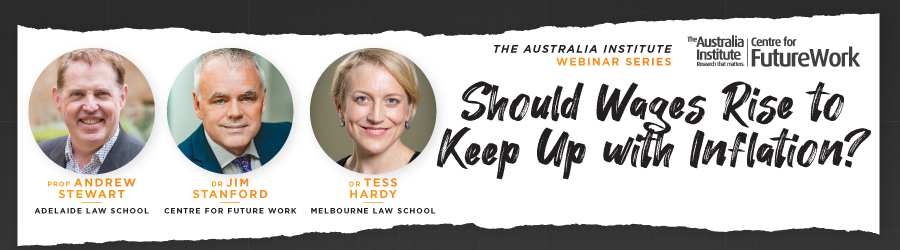
    The three authors of that report – Prof Andrew Stewart from the Adelaide Law School, Assoc Prof Tess Hardy from Melbourne Law School, and the Centre for Future Work’s Director Jim Stanford – participated in a webinar hosted by our colleagues at the Australia Institute. They reviewed the main findings of the report, and answered several questions from the audience about the wages crisis and possible solutions. The webinar was hosted by Ebony Bennett, Deputy Director of the Australia Institute.

    Our team has also been working to analyse the implications of the latest wages data for real incomes, macroeconomic performance – and the federal election, in which wages have emerged as a major point of contention. Please see the following analysis from our team:

    Our team will continue to research the dimension, causes, consequences, and potential solutions to the worsening wages crisis in the coming weeks — no matter who wins Saturday’s election!

    The post More Resources on Australia’s Wages Crisis appeared first on The Australia Institute's Centre for Future Work.

  • Webinar: Changes to the SCHADS Award and Next Steps to Improve Job Quality

    We recently hosted a special webinar to discuss the Commission’s changes, their significance, and what comes next in the struggle to improve and properly value work in human services.

    The webinar featured two representatives from the Australian Services Union, which was centrally involved in the campaign for these changes: Emeline Gaske, Assistant National Secretary for the ASU, and Michael Robson, National Industrial Coordinator. They reviewed the economic and policy context for the review, the specific changes that have been announced, how they will be implemented, and the next steps in lifting the quality of work in these vital sectors. The conversation was chaired by our Policy Director for Industrial and Social issues, Dr. Fiona Macdonald.

    The post Webinar: Changes to the SCHADS Award and Next Steps to Improve Job Quality in Human Services appeared first on The Australia Institute's Centre for Future Work.

  • One in Five Worked with COVID Symptoms; Sick Leave Entitlements Must Be Strengthened

    Almost one in five Australians (and a higher proportion of young workers) acknowledge working with potential COVID symptoms over the course of the pandemic, according to new opinion research released today by the Australia Institute’s Centre for Future Work.

    The research confirms the public health dangers of Australia’s patchwork system of sick leave and related entitlements, as new ABS data released today indicates 32% of Australian households had one or more members exhibiting COVID symptoms in April.

    Key Findings:

    • More than one in three (37%) employed Australians have no access to statutory paid sick leave entitlements (including workers hired under casual employment arrangements, and self-employed workers). Another 12% had access only to pro-rated part-time entitlements.
    • When the pandemic hit Australia, therefore, barely half (51%) of employed workers could count on regular full-time income if they had to stay home from work.
    • Almost one in five respondents (19%), and a higher proportion of young workers (29%), acknowledged working with potential COVID symptoms at some point during the pandemic. This highlights the public health dangers of Australia’s patchwork system of sick leave and related entitlements.
    • Polling results also confirm that a significant proportion of workers (17%) also attended work after exposure to someone possibly infected with COVID.
    • Given inadequate sick pay entitlements and the surprising share of workers attending work in violation of public health advice, perhaps it is not surprising that 18% of workers did not feel safe attending their normal workplaces during the pandemic.
    • Australia’s sick pay entitlements are clearly inadequate to allow workers to stay home from work when health advice requires it. The expansion of non-standard and insecure forms of work (including part-time work, casual jobs, contractor positions, and ‘gigs’) has heightened concern that many workers do not have the effective ability to stay home from work for health reasons.
    • Government should expand sick pay entitlements to cover all workers, and also implement strategies to limit and reduce the incidence of insecure work: including by constraining employers’ use of ‘permanent casual’ arrangements, sham contracting, and on-demand gigs, none of which provide normal and healthy paid leave entitlements.
    • Unfortunately, the current Federal Government has done the opposite by reinforcing the shift toward insecure working arrangements – including through its 2021 amendments to the Fair Work Act, which cemented and expanded employers’ rights to hire workers on a casual basis (with no sick pay) in virtually any job they wish.

    “Our research shows that too many workers are not following public health guidelines and isolation instructions, to the detriment of their own health, and the health of their colleagues and the broader community,” said Dr Jim Stanford, economist and director of the Australia Institute’s Centre for Future Work.

    “Millions of workers have either used up all the paid sick leave they are entitled to, or do not receive sick pay entitlements in the first place. There is no doubt this has contributed to the epidemic of people attending work with possible COVID symptoms.

    “With incomplete sick leave coverage, workers face a devil’s choice: between staying home to protect themselves, their colleagues and the public; or going to work regardless simply to make ends meet.

    “The policy implications of this analysis are clear. The government needs to expand sick pay entitlements to cover all workers, including those in casual employment and self-employed situations.”

    The post One in Five Worked with COVID Symptoms; Sick Leave Entitlements Must Be Strengthened appeared first on The Australia Institute's Centre for Future Work.

  • Wages Will Continue to Lag Without Targeted Wage-Boosting Measures: New Report

    A comprehensive review of Australian wage trends indicates that wage growth is likely to remain stuck at historically weak levels despite the dramatic disruptions experienced by the Australian labour market through the COVID-19 pandemic. The report finds that targeted policies to deliberately lift wages are needed to break free of the low-wage trajectory that has become locked in over the past nine years.

    The report, The Wages Crisis: Revisited, authored by three of Australia’s leading labour policy experts: Professor Andrew Stewart from Adelaide Law School, Dr Jim Stanford from the Centre for Future Work, and Associate Professor Tess Hardy from Melbourne Law School, updates analysis and recommendations from their 2018 edited book, The Wages Crisis in Australia.

    The report shows that annual nominal wage growth recovered after initial lockdowns during the pandemic – but rebounded only to the same slow pace (just above 2% per year) recorded for several years prior to COVID. Unprecedented fluctuations in employment and labour supply, including a significant decline in the official unemployment rate, do not seem to have altered wage growth, which is still tracking at the slowest sustained pace in post-war history.

    “It is striking that despite so much turmoil in our labour market during and after the pandemic, wage growth is still stuck at historically weak rates,” noted Professor Andrew Stewart.

    The research found little correlation between the lasting slowdown in wage growth after 2013, and changes in supply-and-demand balances in the labour market.

    “Traditional market forces did not cause the wages crisis, and market forces are unlikely to be able to fix it – even with a relatively low unemployment rate,” said Dr Jim Stanford.

    Instead, the authors identified nine policy and institutional factors which were more important in explaining the deceleration of wages, including: the erosion of collective bargaining coverage; inadequate minimum wages; pay restraint imposed on public sector workers; and widespread wage theft.

    The problem of restrained compensation in public and human services reaches further than just the pay caps imposed directly on public servants. Wages in publicly funded services (like aged care, the NDIS, and early child education) are also held back by inadequate funding and weak labour standards in those programs.

    The report makes special mention of the need to improve wages in aged care, in the wake of the recent Royal Commission’s finding that wages in the sector must be improved as a top priority in improving care standards and attracting the new workers the sector needs.

    “A combination of underfunding, outsourcing, and precarious employment has suppressed wages for some of the most important jobs in our economy,” commented Associate Professor Tess Hardy. “The Aged Care Royal Commission identified this problem, and directed government to solve it, but so far the government has done nothing to improve wages.”

    The authors suggest that nominal wages should grow faster than 4% per year in coming years, to restore healthy relationships with productivity growth, inflation, and national income distribution. But a resuscitation of wage growth will not occur without proactive wage-boosting policies.

    The authors list five broad measures to quickly support wage growth. One is a proposal for a new statutory definition of employment. This would prevent businesses from drafting contracts that present workers as being self-employed, even if in reality they have no business of their own. The authors predict that such arrangements will become far more widespread, including in the growing gig economy, in the wake of two recent decisions by the High Court.

    “The High Court has said that employment status has to be determined by what your contract says, not what you actually do. That opens the door to much wider use of contractor models, even when the actual conditions of work clearly indicate an employment-like relationship”, said Prof Stewart. “Without urgent action to prevent minimum wage laws being avoided in that way, the negative impacts on wages will steadily become much worse.”

    The post Wages Will Continue to Lag Without Targeted Wage-Boosting Measures: New Report appeared first on The Australia Institute's Centre for Future Work.

  • Pandemic Workforce Crisis Requires TAFE Investment in Early Childhood Education: Report

    The research report launched today, ‘Educating for Care: Meeting Skills Shortages in an Expanding ECEC Industry’ has called for the sector to be treated as an ‘industry of national strategic importance’ with greater investment in TAFE to train staff.

    Key Findings:

    • The number of job vacancies in Early Childhood Education and Care sector have doubled since the pandemic with providers reporting 6000 job vacancies per month
    • Australia is failing to train & retain its ECEC workforce, problem is set to worsen as 41,500 new graduates will be required per year by 2030
    • Beyond direct benefits, ECEC expansion boosts productivity across the economy by unlocking labour market participation of parents
    • Early childhood education enhances the long-term potential of Australia’s economy by providing children with education opportunities to expand lifetime learning, employment, & incomes
    • Among the 10 key recommendations, is that ECEC should be viewed as an ‘industry of national strategic importance’, similar to the manufacturing industry

    “Workforce shortages have been a problematic reality of the pandemic, both within the Early Childhood Education sector and across the broader economy,” said Dr. Mark Dean, Distinguished Research Fellow at the Carmichael Centre, and report author.

    “The early childhood education and care workforce crisis is set to get worse. This represents a huge opportunity: greater investment in TAFE training and secure jobs can unlock economic growth and deliver better outcomes for our children and the Australian economy.

    “It would be foolish to overlook the full and proper funding of Australia’s state- and territory-based TAFE systems in our post-pandemic economic reconstruction, rather than seeing it as an essential component.

    “To tackle the problem, education and care for preschool-aged children should be provided by well-trained and experienced workers. Like any industry, attracting and retaining quality early childhood education staff will require quality, secure jobs.

    “To meet the workforce needs of expanded ECEC coverage, ramping up high-quality vocational education for ECEC workers must be an immediate and highest-order priority.

    “A vital prerequisite in this effort is establishing a stable, professional, well-supported ECEC workforce, by providing extensive education and training of ECEC workers, and their entry to secure, well-paid career pathways.”

    The post Pandemic Workforce Crisis Requires TAFE Investment in Early Childhood Education to Boost Economy: Report appeared first on The Australia Institute's Centre for Future Work.