Author: Future Admin

  • Wages, employment and power: Call for conference papers

    The Centre for Future Work is hosting a stream at the upcoming AIRAANZ Conference.

    Join us as we continue the AIRAANZ and the Centre for Future Work traditions of bringing researchers and activists together to debate important issues in the world of work and industrial relations.

    The AIRAANZ (Association of Industrial Relations Academics of Australia and New Zealand) 2024 Conference will be held in Perth from the 31 January to 2 February 2024.

    Wages, employment and power
    Papers are sought on topics that relate to issues concerning employment, power and/or wages.

    Topics could include, but are not limited to:

    • the relationship between power and wages at the firm, industry or national level;
    • legislative reforms affecting wages, employment or power;
    • bargaining strategies to boost power and wages;
    • explanations for changing worker power;
    • job vacancies, labour shortages and wages;
    • the gendering of wages, employment or power;
    • employment, unemployment or participation amongst particular groups or industries;
    • product or labour market competition and worker power;
    • the effects of norms and institutions in labour markets;
    • the geography of power or wages;
    • the ideologies and strategies of employers, unions or the state.

    Submit your abstract to the conference organisers by 29th September.

    Feel free to get in touch with us if you have any questions about topics or the stream or would like any additional information.

    David Peetz d.peetz@griffith.edu.au, davidp@australiainstitute.org.au, +61 466 166 198 or +64 204 127 6749
    Fiona Macdonald fiona@australiainstitute.org.a, +61 437 301 065

    Abstracts must be submitted to the conference organisers via: https://consol.eventsair.com/airaanz-2024/submission-site/Site/Register.

    For AIRAANZ 2024 Conference details see: https://www.airaanz.org/conference/reimagining-industrial-relations-airaanz-2024-conference-31-jan-2-feb-2024/

    The post ‘Wages, employment and power’: Call for conference papers appeared first on The Australia Institute's Centre for Future Work.

  • Report Reveals True Potential of Fully Funded Public Schools

    “The Case for Investing in Public Schools: The Economic and Social Benefits of Public Schooling in Australia” has found that the current inadequate funding for public schools is preventing students from reaching their full potential and is depriving the nation of the significant benefits of high levels of school completion.

    The report simulates the short-run and long-run economic benefits arising from the 15% increase in public school funding that would be required to meet the minimum resource benchmarks established through the Schooling Resource Standard (SRS).

    Key findings:

    • Inadequate funding is linked to falling school completion rates and declining relative performance in international achievement. Students from relatively disadvantaged socio-economic, regional, and Indigenous backgrounds are most likely to be affected.
    • Additional funding of $6.6 billion per year is needed for public schools to meet the SRS commitments adopted by federal and state governments a decade ago, a 15% increase in total public school funding.
    • With additional resources, the decline in high school completion rates that has occurred since 2017 could be repaired under a modest estimate, and further gains in completion (in line with historical trends) attained under an optimistic estimate.
    • The enhanced funding and resulting improvements in school completion could lead to employment, economic activity, productivity gains and social savings equal to $17.8 billion and $24.7 billion annually (in 2022 terms) after two decades.
    • These economic benefits are two to four times greater than the additional yearly cost required to fully meet the SRS for public schools.
    • Fiscal improvements resulting from these economic gains, such as increased tax revenues and reduced social expenditures, would eventually offset the incremental resources needed for full SRS funding.

    “Australia’s economic success relies heavily on the potential of our young minds,” said Dr Jim Stanford, Director of the Centre for Future Work, and co-author of the report (with Eliza Littleton and Fiona Macdonald).

    “Public schools play a critical role in ensuring that students have access to an education that provides them with choice and opportunity throughout their lives – regardless of their postcode or economic and family circumstances.

    “With stronger school completion and academic achievement, our communities thrive and our nation benefits from increased economic activity, productivity and earnings.

    “The total economic benefits arising from adequate public-school resourcing would be two to four times larger than the cost of meeting SRS funding standards. The fiscal gains associated with those economic benefits would ultimately offset the cost to government of improved public school funding.

    “Every dollar invested in public education translates into a stronger, more cohesive, and prosperous society. Let’s not rob our students, and our nation, of this opportunity,” Dr Stanford concluded.

    The post Report Reveals True Potential of Fully Funded Public Schools appeared first on The Australia Institute's Centre for Future Work.

  • Australia at risk of exclusion from renewable manufacturing boom

    Australia risks being left out of lucrative new markets for renewable energy-related manufacturing unless government provides an urgent, domestic response to match powerful incentives introduced by the U.S and several other industrial nations.

    The finding is published in a new report released today by the Australia Institute’s Centre for Future Work, as part of the 4th National Manufacturing Summit, being held in Canberra.

    Key points:

    • There is an overseas manufacturing boom in the productions of batteries, electric vehicles, renewable energy generation and transmission equipment, and other renewable energy products.
    • This boom is being driven by incentives provided by the Biden Administration’s Inflation Reduction Act, and similar supports in the EU, China, Japan, Korea, and Canada.
    • Meanwhile, Australia is considering its response, but no clear strategy has been announced.
    • The report estimates the proportional investment required to match the American IRA in the Australian context at between $83 to $138 billion over 10 years in fiscal supports and incentives to match U.S. benchmarks.
    • Several qualitative best practices should also be included in the Australian response to the IRA to generate maximum economic, social, and environmental impact: these include strong labour and environmental standards attached to subsidised projects, public equity participation, and parallel investments in training for workers to fill the new jobs.

    “The extraordinary response by industry to the U.S. measures confirms that these policies are having an outsized effect on the volume and location of sustainable manufacturing investment,” said Dr. Jim Stanford, Director of the Centre for Future Work and co-author of the report.

    “It also confirms that Australia must move quickly with its response to this new industrial landscape, or risk losing its chance to leverage our renewable energy resources into lasting, diversified industrial growth.”

    Charlie Joyce, a research fellow at the Centre and co-author of the report, noted: “The global race for clean technology manufacturing is well underway, and Australia is barely on the track.”

    “Australia has many advantages when compared to other competitors in this market, including an unmatched endowment of renewable energy sources and ample deposits of critical minerals.

    “However, the painful legacy of decades of policy neglect for domestic manufacturing has left our industrial base in poor shape to seize the opportunities opening up ahead of us.”

    “If we don’t support domestic manufacturing to quickly enhance its production, skills, and technological capabilities, all that will happen is we will replace one set of unprocessed minerals: coal, oil and gas; with another: raw lithium and related critical minerals.”

    “Without action, most of the spin-off benefits of the renewable energy revolution for industry, technology, value-added and diversification will pass us by,” said Mr. Joyce.

    The report estimates the proportional investment required to match the American IRA in the Australian context at between $83 to $138 billion over 10 years in fiscal supports and incentives to match U.S. benchmarks.

    “That is a big fiscal ask by any standards, but not out of reach for Australia,” said Dr. Stanford. “But the common claim that Australia cannot afford to undertake proportionately equivalent measures is not convincing.”

    “Our federal budget is in much better shape than the U.S. And the government has committed to other, less pressing priorities which are just as expensive – such as nuclear submarines, Stage 3 tax cuts, and ongoing fossil fuel subsidies.”

    Please see the full report, Manufacturing the Energy Revolution: Australia’s Position in the Global Race for Sustainable Manufacturing, by Charlie Joyce and Jim Stanford.

    The paper is being released at the 4th National Manufacturing Summit, being held at Old Parliament House in Canberra from 8.30am to 4.30 pm on Thursday, August 3, co-sponsored by Weld Australia, the Centre for Future Work, and several industry bodies.

    The post Australia at risk of exclusion from renewable manufacturing boom appeared first on The Australia Institute's Centre for Future Work.

  • Australian and Global Union Leader Sharan Burrow to Deliver Second Annual Carmichael Lecture

    Former ACTU president Sharan Burrow will deliver the second annual Carmichael Lecture.

  • Fair Work: 5.75% Award Wage Boost will not cause Wage-Price Spiral

    Today’s 5.75% award wage increase is a necessary boost for the lowest paid workers but does not keep pace with inflation.

    The Fair Work Commission (FWC) has today explicitly said this increase “will consequently not cause or contribute to any ‘wage price spiral’”.

    Key Points:

    • Award wage increase of 5.75% is less than inflation, which is running at 7%. (This covers approx. 20% of workers)
    • FWC Commission have said explicitly this will not cause or contribute to a so-called ‘wage-price spiral’
    • FWC acknowledges the increase “will not maintain the real value of modern award minimum wages nor reverse the reduction in real value which has occurred”
    • Australia Institute research shows excess corporate profits, not wages, are the major driver of inflation
    • Fair Work Commission also increased the national minimum wage by 8.65% (this covers approx 0.7% of workers)

    “This is a necessary boost, but insufficient to keep the lowest paid workers ahead of inflation,” said Dr. Greg Jericho, Policy Director at the Australia Institute’s Centre for Future Work.

    “It’s significant that the Fair Work Commission has explicitly said this will “not cause or contribute to any wage-price spiral”. At a time when companies are making record profits, our research shows profits, not wages, are the major driver of inflation.

    “The FWC notes it “will make only a modest contribution to total wages growth in 2023-24 and will consequently not cause or contribute to any wage-price spiral.

    “The FWC has made it clear the Reserve Bank can not blame low paid workers wages for driving inflation in the event they raise interest rates next week.”

    Excerpt from Fair Work Commission Decision:

    As the total wages of modern award-reliant workers constitute a limited proportion of the national wage bill, we are confident that the increase we have determined will make only a modest contribution to total wages growth in 2023-24 and will consequently not cause or contribute to any wage-price spiral.

    We acknowledge that this increase will not maintain the real value of modern award minimum wages nor reverse the reduction in real value which has occurred over recent years.

    The post Fair Work: 5.75% Award Wage Boost will not cause “Wage-Price Spiral” appeared first on The Australia Institute's Centre for Future Work.

  • Profit-Price Spiral an Inconvenient Truth for Big Business: Economists

    New media reports today quoting former Australian Competition and Consumer Commission Chair Rod Sims have reaffirmed the findings of Australia Institute research showing excess profits from companies like Coles and Woolworths are significant contributors to inflation.

    Key Points:

    “That the business lobby has been unable to disprove a single number from our research is a testament to the careful, evidence-based nature of our work,” said Dr. Jim Stanford, Director of the Centre for Future Work and report author.

    “It’s notable that many of the voices now seeking to cast doubt on the evidence behind a profit-price spiral were silent during the prolonged rhetoric on the existence of a wage-price spiral.

    “The report ‘Profit-Price Spiral: the Truth Behind Australia’s Inflation’ contained new macroeconomic data confirming that increasing profit margins per unit of real output in Australia’s economy account for a strong majority (over two-thirds at that time, based on September quarter 2022 data) of above-target inflation since the outbreak of the COVID pandemic in early 2020. The data we presented on the surge in profits, coincident with rising inflation, is clear, sourced to ABS data, and has not been challenged.

    “The RBA’s internal correspondence about our report (released as part of a freedom of information request) in fact replicated and verified our finding that rising profit margins account for the bulk of increased nominal valuations in Australia, comparing end-2019 to late-2022.

    “Macroeconomic trends since then (including December quarter 2022 data released after our initial report) confirm that unit profit margins are still elevated.

    “Contrary to the view of some Australian commentators, numerous high-quality research reports from think tanks, universities, and even central banks in other countries have confirmed the importance of rising profit margins in explaining the acceleration of inflation since the COVID pandemic, using methodological approaches similar to our own statistical decomposition. We cited several of those complementary studies in our follow-up report, Profits and Inflation in Mining and Non-Mining Sectors, and other similar research has been published more recently.

    “The main thrust of the critical commentary on our report has not been to challenge its empirical findings on the rapid increase in profits, but rather to deny that any generalised increase in profitability has been the cause of the inflation. Some claim that the rise in profits has been limited to the mining sector, which somehow doesn’t ‘count’ – even though products produced by that sector (including petrol, gas, and other fossil fuels) have been a leading source of recent inflation.

    “Our subsequent research showed that profit margins have also increased (albeit less dramatically) in several non-mining sectors. Others claim that swollen profits are just a side-effect of inflation that was caused by other forces (usually including supposed excess wage growth or consumer disposable incomes). That debate over the direction of causation is rather moot: the undeniable reality is that profits are at all-time record levels in Australia, while workers’ real wages continue to decline.

    “Business peak bodies who argue for continued wage suppression desperately want to hide the reality that they have profited from the inflation that is causing a crisis in living standards. This explains their interest in trying to challenge our findings.

    “The Australia Institute stands by its research. Arguing about the dimensions, causes, and remedies of the inflation problem is a normal part of the national economic debate. We look forward to similar scrutiny being applied to those arguing that wages are driving inflation in Australia.”

    The post Profit-Price Spiral an Inconvenient Truth for Big Business: Economists appeared first on The Australia Institute's Centre for Future Work.

  • Workplace Law Reform Must Limit Cancer of Gig Work in Care Economy: Research

    Researchers have recommended limits are placed on the growth of gig work in the NDIS as part of the third tranche of the Commonwealth Government’s industrial relations reforms later for later this year. Researchers say the promised reforms to ‘Employee-like’ forms of work should be used to protect minimum employment standards and quality service delivery for care workers and consumers.

    Key findings

    • The gig work model is growing in the care economy and NDIS, undermining wages, conditions and gender pay equality
    • Care workers on platforms are younger, less experienced and more likely to be migrant workers than workers in the broader care and support workforce.
    • Platform care work is insecure on-demand work, working time is fragmented, pay can be unpredictable. Many workers’ earnings are equivalent to below award-level pay.
    • Worker-friendly flexibility is limited and is mainly only possible in short hours jobs. Flexibility comes at the expense of a living wage.
    • Care and support platform workers are isolated and largely invisible, working in private homes without organisational supervision, support, guidance or training.
    • In platform and other independent contracting arrangements, risks and responsibilities for care quality and client safety are devolved to individual workers.
    • Platforms compete by avoiding the costs and risks of business fluctuations, of employing workers and of accountability for care and support quality and safety. Costs and risks are devolved to low-paid and insecure frontline workers.
    • Platforms profit from retaining funds that are allocated for employong workers and providing training and supervision.

    “Unregulated gig work is a cancer for workers rights in Australia,” said Dr Fiona Macdonald, Policy Director, at the Australia Institute’s Centre for Future Work.

    “The growth of gig work on digital platforms in the care economy eats away at minimum employment conditions and shifts risk on to care consumers and staff.

    “Care is a public good. Stopping the gigification of disability and aged care workforces is necessary to prevent public funding allocations for essential workers’ wages, superannuation, training and supervision from being diverted to profits.

    “Sector-specific reforms are currently being considered for the road transport industry. Yet, in the public care and support sectors, the same concerns—safety, sustainability and viability—are being approached through disconnected policy processes, rather than being addressed head on.

    “The Women’s Budget Statement reiterated the Government’s commitment to ‘a sustainable and productive care and support economy that delivers quality care and decent jobs’. Gig care work should be addressed with a view to gender equality.

    “We are seeing the Gigification of care work and, without protections, we will risk seeing this spread to other sectors of the labour market.”

    Recommended policy responses:

    • The Government has committed to reforms to ‘Employee-like’ forms of work in 2023
    • These reforms must be designed to restore full employment rights and benefits to all care and support workers, including minimum wages, super & WHS
    • Comprehensive employment minimum standards should apply for all care and support workers, regardless of employment status
      Digital platforms in the care sector should be bound by mandatory codes of conduct

    The post Workplace Law Reform Must Limit Cancer of ‘Gig Work’ in Care Economy: Research appeared first on The Australia Institute's Centre for Future Work.

  • Affordability of a Liveable Jobseeker Payment is a Non-Issue

    Commonwealth on Track for Diminutive Deficit or Surplus in 2022-2023

    In the lead-up to its 2023-24 budget, the Labor Government finds itself in an awkward position, accepting that the Jobseeker payment is “seriously inadequate” and an impediment to regaining work, yet professing that it lacks the financial capacity to afford a meaningful increase anytime soon.

    The Economic Inclusion Advisory Committee’s (EIAC) April 2023 Interim Report recommended raising Jobseeker from 70% of the Pension up to 90%. The current Jobseeker base rate for a single person with no children is $693.10 per fortnight. Lifting it up to 90% of the current Pension payment of $971.50 per fortnight would provide the unemployed with an extra $181.25 per fortnight (or $12.25 per day).

    Labor has baulked at the cost of the EIAC’s Jobseeker proposal. There is speculation that the upcoming budget will include a $50 per fortnight increase in the Jobseeker payment for those over 55 years of age. It is unclear if that increase will apply to everyone over 55 years of age, or just to the 55 to 59 year old cohort who are currently ineligible for the additional $52 per fortnight already available to those over 60 and who have been unemployed for longer than nine months.

    A $3.57 per day rise in the Jobseeker payment for those over 55 years of age (or between 55 and 59) seems rather stingy. One might expect that the plight of the unemployed—among the least well-off and most financially-constrained members of society—would be a high priority in the middle of a cost-of-living crisis.

    Before last year’s election, the Labor party abandoned a previous pledge to raise Jobseeker payments, on concerns about growing Commonwealth government debt. The EIAC then only came about as a concession to gain Senator David Pocock’s support for the Secure Jobs Better Pay Act 2022.

    Labor’s meme of “inheriting a trillion dollar debt that will take generations to pay off” has echoed the Coalition’s 2013 so-called “budget emergency”, also used to blame the preceding government. The nation’s allegedly dire fiscal position was cited by Bill Shorten as justification for not adopting the EIAC’s key recommendations: ‘We can only do what is responsible and sustainable and unfortunately the budget we inherited from the previous government is heaving with a trillion dollars of Liberal debt, so [we] can’t do everything.’

    The strategy of deflecting accountability for policy choices on grounds of fiscal constraint has become less credible, given the robust post-pandemic economic recovery and the boom in commodity prices – all of which has generated large improvements in the Commonwealth government’s fiscal position. As illustrated in Figure 1, the government’s underlying cash deficit for the current financial year (2022-23), once expected to be $100 billion, has shrunk dramatically.

    Sources: Australian Government, Budget Papers, Monthly Financial Statements. Author’s calculations.

    Indeed, the Commonwealth Government’s latest Monthly Financial Statements show that it is on track to post a very small deficit, or even a surplus, for the 2022-23 financial year. As of March 2023 the underlying cash balance (UCB) had improved by $23.3 billion over the estimates in the October 2022-23 Budget. If the year-to-date deficit changes little in the last quarter, and with higher GDP than previously estimated, then the UCB in 2022-23 would come in at a diminutive -0.5% of GDP. That’s insignificant by any meaningful economic standard.

    Further upside is possible. If the average monthly improvement from November 2022 to March 2023 continues in the last quarter of the financial year, the UCB in 2022-23 would be a surplus of $2.8 billion.

    Australia’s public debt load – also measured appropriately as a proportion of GDP (rather than in big scary ‘trillion dollar’ terms) is also modest when compared to the nation’s peers and to its own historical record. Our general government debt (including state governments) is lower than any G7 economy, and half the size of the average for advanced economies. The same cannot be said, however, for Australian households: their debt is higher than any G7 economy, and ranks second (behind only Switzerland) among all industrial countries (see Figure 2).

    Figure 2: Government and Household Debt

    Sources: International Monetary Fund, World Economic Database. Bank for International Settlements, Credit to the Non-Financial Sector.

    Having switched from “opposition mode” into “governance mode,” it makes sense for Labor to start to talk up the nation’s public finances. Such a narrative would be plausible given that Australia’s fiscal position is robust and sustainable: now and into the foreseeable future. That is the current assessment of the International Monetary Fund in its latest Article IV Consultation, amongst others.

    The prospect for further substantial improvement in the UCB over the forecasts – and perhaps even a surplus – should raise expectations about what the government can do to ease cost-of-living pressures. Arguably, however, a liveable unemployment benefit should be prioritised regardless of the economic and fiscal outlook.

    The EIAC’s Jobseeker proposal is estimated to cost $24 billion over four years. Implementing all of the EIAC’s other recommendations brings the cost to $36 billion. The annual cost of the full package would amount, respectively, to just 0.3% of GDP in the next financial year. Such expenditures, while having a diminutive impact on the Commonwealth Government’s fiscal position, would literally transform the lives of the unemployed.

    When all is said and done whether a nation should have a liveable unemployment benefit is a question of principles. There is an obvious option for Labor to allay its worries about the budgetary or inflationary pressures of a liveable Jobseeker payment: namely, jettison the 2024-25 Stage 3 tax cuts, that are estimated to cost $300 billion over the first nine years. Tax cuts that mainly benefit high-income earners make no sense in an economic landscape where over 90% of the pre-tax income gains from growth in national income have in recent experience gone to the highest-income 10% of households.

    The reluctance of the government to discard or redesign the Stage 3 tax cuts is attributed by some to the Labor Party’s pre-election commitments. It remains that the tick boxes for good governance do not include steadfast adherence to suboptimal policy positions. Overseeing regressive tax cuts, while being unwilling to meaningfully improve the lot of the least well-off, has those principles back-to-front.

    Dr Brett Fiebiger is a post-Keynesian economist. His research focuses on macroeconomic policy, growth theory and income distribution.

    The post Affordability of a Liveable Jobseeker Payment is a Non-Issue appeared first on The Australia Institute's Centre for Future Work.
  • 7% Minimum Wage Rise Would Tackle Inflation, not Feed it: Research

    A 7% minimum wage rise would have a virtually undetectable impact on economy-wide prices.

  • Women Earn $1m less than men & $136,000 Less in Super over Working Life

    New research released on International Women’s Day reveals Australian women earn $1.01m less over their working lives than men, based on median income data.

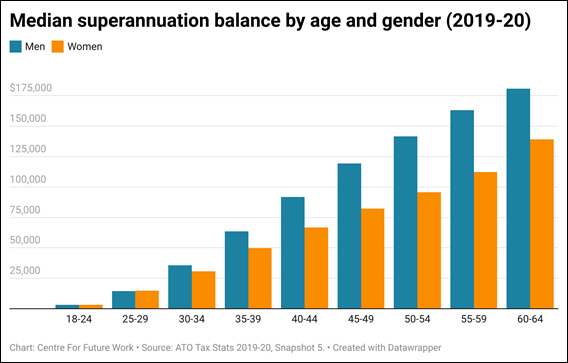
    Women earn $136,000 less in superannuation over their working lives than men, based on median income data. Women earning the median wage will accumulate approximately $393,676 in super, $151,000 below what is considered a ‘comfortable retirement’. The average super balance in Australia in 2023 is $150k.

    Experts say if the gender pay gap was eliminated women would be $3 billion per week better off.

    Despite the gender pay gap narrowing slowly, based on data from the past decade it will only be eradicated by the year 2053 when more than 60% of the current workforce will be retired.

    Key Points:

    • Australian women on a median income will earn $1.01m less over their working lives on average than their male counterparts.
    • Australian women on a median income will earn $136,000 less in superannuation over their working lives than their male counterparts.
      • Women earning the median wage will accumulate approximately $393,676 in super, $151,000 below what is considered a ‘comfortable retirement.
      • The average super balance in Australia in 2023 is $150k.
    • Experts say if the gender pay gap was eliminated women would be $3 billion per week better off.
    • The gender pay gap is narrowing so slowly that it will not fully close for another 30 years until 2053. At that stage 60% of people currently working will have retired.
    • The Gender wage gap in Australia (15.3%) is more than double what it is in New Zealand (6.7%)
    • The gender gap occurs across all occupations and industries:
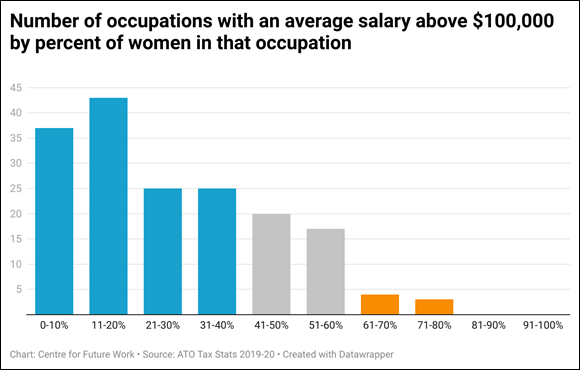
      • Men have higher average salaries than women in 95% of all occupations, including those where women dominate the workforce. For example, women account for 99% of all midwives, and yet are paid on average 19% less.
        • 80 occupations in which men make up 80% or more of the workforce have an average salary above $100,000.
        • By contrast zero occupations in which women make up 80% or more of the workforce have an average salary above $100,000.

    “For the average woman in Australia, the gender pay gap will be more than $1.01m over her working life, based on conservative estimates,” said Senior Economist Eliza Littleton from the Australia Institute’s Centre for Future Work.

    “There’s been a noisy political debate about super in Australia for the past week, but this data shows that based on median income data Australian women will earn $136,000 less than their male counter parts over their working life. When you consider that the average super balance in Australia right now is approximately $150,000, that’s a huge disparity.

    “Australian women continue to be paid less than men on average across all industries and occupations, costing us more than $3b across the economy each week.

    “We know that older women are one of the most vulnerable groups when it comes to poverty and homelessness in Australia.

    “Australian women shouldn’t have to wait until the year 2053 for substantive equality. We deserve equity today and our research makes several sensible policy recommendations for the Labor Government to action.”

    Policy recommendations:

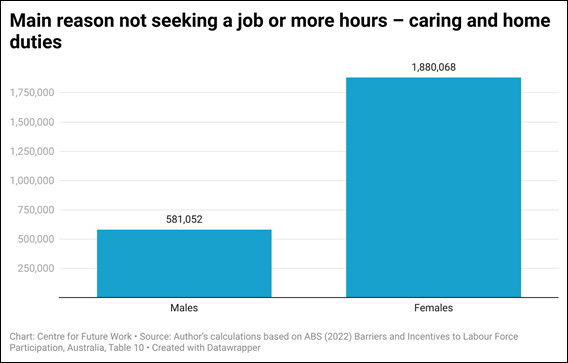
    • Greater access to free or more affordable earlier childhood education & care: Australia Institute research shows if Australia had the same labour force participation rates as Nordic countries do, then the economy would be $60 billion, or 3.2% of GDP, larger (Grudnoff and Denniss, 2020).
    • More paid parental leave for both parents: Australia’s PPL scheme is well behind international standards. The OECD average PPL scheme is 60 weeks in total, with 24.6 weeks reserved for mothers, 10.4 weeks for fathers and 25.4 weeks that can be flexibly distributed (OECD, 2022). With a 20-week scheme, Australia unsurprisingly ranks low – 30th out of 38 countries for the duration of paid leave entitlements. Extending leave entitlements and encouraging a more even distribution of childcare would help reduce the career and financial penalty of having children both for all parents, but especially women. Additionally, making it mandatory for superannuation to be paid while a person is taking paid parental leave would help to reduce the gendered super gap.
    • Greater family-friendly work practices: Some workplaces and workers have managed to maintain flexible working arrangements, but this should be standardised, expanded and embedded in employment relations frameworks to make balancing work and care more achievable across the workforce. Breaking down rigid job design in male-dominated jobs could also help with reducing entrenched gendered segregation by industry and occupation.
    • Deliberate policy to lift the wages for industries dominated by women — most urgently in the care sector: Women dominated sectors, especially in the care industry are among the lowest paid work. The 2021 Royal Commission into Aged Care Quality and Safety recommended that gig work, independent contracting and other ‘indirect’ employment arrangements be restricted in the publicly-funded aged care sector. This needs to be agreed to.
    • Address insecure work: Further reforms should include rights to family-friendly working time arrangements and stable work as minimum standards for all employees in the National Employment Standards.
    • Full recommendations in attached report

    The post Women Earn $1m less than men & $136,000 Less in Super over Working Life appeared first on The Australia Institute's Centre for Future Work.