Author: Future Admin

  • ABCC will do nothing for housing prices: Report

    Prime Minister Turnbull blamed construction workers and their union for the high cost of housing, when he re-introduced the ABCC bill in Parliament last month, claiming the bill would help “young Australian couples that can’t afford to buy a house because their costs are being pushed up by union thuggery.”

    But new research from the Centre for Future Work shows there is no statistical correlation between construction unionization or construction wages, and the soaring cost of housing.

    “The government’s claim that construction labour costs explain the rising price of housing has no basis in evidence,” Director of the Centre for Future Work, Jim Stanford said.

    “The suggestion that restricting union activity in construction can somehow deflate the great Australian property bubble reveals a critical misunderstanding of the Australian housing market.”

    The study provides detailed statistics regarding housing prices, union membership, wage growth, total construction costs, and replacement building costs. The report finds that:

    • Construction wages have grown more slowly than the Australian average over the last five years.
    • Real wage gains in construction have been slower than real productivity growth, and hence real unit labour costs in construction have declined.
    • Construction labour accounts for only 17-22 percent of the total costs of new building.
    • Construction costs, in turn, account for less than half the market value of residential property.
    • Construction labour costs correspond to less than 10 percent of housing prices (and even less than that in Australia’s biggest cities).
    • Construction labour accounts for about the same proportion of a house purchase as real estate commissions and stamp duty.

    “Homes in Australia are fast becoming unaffordable, even for the workers who build them. On average, a construction worker now needs 9.2 years of pre-tax earnings to purchase a median home – up 25 percent from just four years ago.

    “If the government is genuine in its desire to make housing more affordable in Australia, it should turn its attention to the real causes of the problem. Better policy responses would include measures to cool off property speculation, more carefully regulate the banking sector, and reform property-related taxes,” Dr Stanford said.

    The post ABCC will do nothing for housing prices: Report appeared first on The Australia Institute's Centre for Future Work.

  • New figures show Australians taking less annual leave

    “This year, Go Home On Time Day will focus on the need for Australian workers to be entitled to, and to feel safe in taking their holiday leave,” Director of The Australia Institute’s Centre for Future Work, Jim Stanford said.

    The Centre for Future Work, which is coordinating this year’s event, published a report which revealed growing number of Australian workers do not qualify for, or are not taking their entitled paid holiday leave.

    A study of 891 workers showed:

    • Almost one-third (32%) don’t have access to paid holiday leave.
    • Over half of those with annual leave didn’t take their whole entitlement.
    • That result would equate, across the whole labour market, to 48 million unused holiday days, worth $11.1 billion – annually.

    “About half of those who responded cited work-related pressures as inhibiting their leave: including being too busy, having too much to do, being reluctant to ask, or worried it would affect their job security or promotion chances.

    “We don’t want to see a nation of empty beaches, unblackened sausages and grandparents waiting too long between visits.

    “We do want to see refreshed workers who have had the chance to spend some quality time with their families,” Stanford said.

    The Unpaid Overtime Calculator app has been used by thousands of Australians, collecting data on excessive hours of work, this year including the provision and use of holiday leave.

    In addition to the growing inaccessibility of paid holidays, the survey data also revealed that the average full-time worker in Australia loses 5.1 hours per week to unpaid overtime – or 264 hours per year. Workers donate $116 billion dollars’ worth of hours to their bosses, every year.

    The post New figures show Australians taking less annual leave appeared first on The Australia Institute's Centre for Future Work.
  • Go Home on Time: Wednesday 23 November

    This year’s Go Home on Time Day is Wednesday, November 23. Visit our special Go Home on Time Day website for more information, to download posters and other materials, and use our online calculator to estimate the value of YOUR unpaid overtime.

    The focus of this year’s Go Home on Time Day is the threat to the “Great Aussie Holiday.” Thanks to the rise of precarious work in all its forms, a growing share of Australian workers (about one-third, according to our research) have no access to something we once took for granted: a paid annual holiday. Moreover, about half of those who ARE entitled to paid annual leave, don’t use all of their weeks – in many cases because of work-related pressures. And recent decisions by the Fair Work Commission allowing for the “cash out” of annual leave, mean that this great cultural institution – the Aussie holiday – is very much in jeopardy.

    Check out our special in-depth report, Hard to Get Away: Is the paid holiday under threat in Australia?, prepared by Troy Henderson of the University of Sydney, documenting these multiple threats to the Aussie holiday, and cataloguing the many economic, social, and health consequences that occur when we don’t get a break from work.

    We have also updated our regular calculations of the value of workers’ time that is effectively “stolen” each year by employers through massive amounts of unpaid overtime regularly worked in all industries and occupations: Excessive Hours and Unpaid Overtime: An Update.

    The post Go Home on Time: Wednesday 23 November appeared first on The Australia Institute's Centre for Future Work.
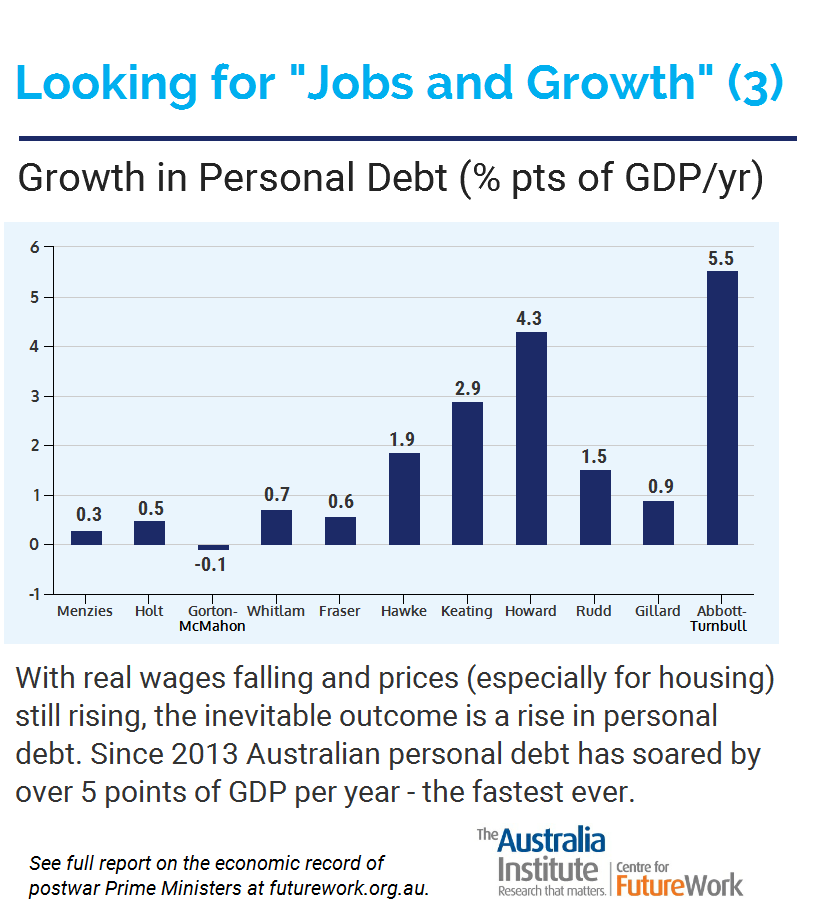
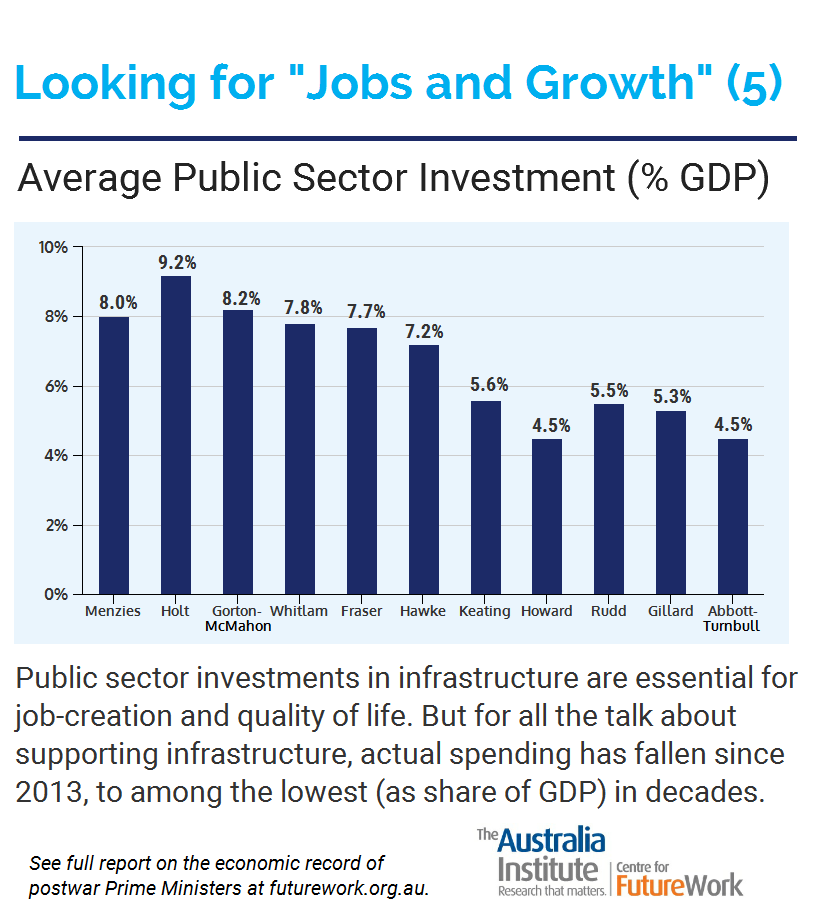
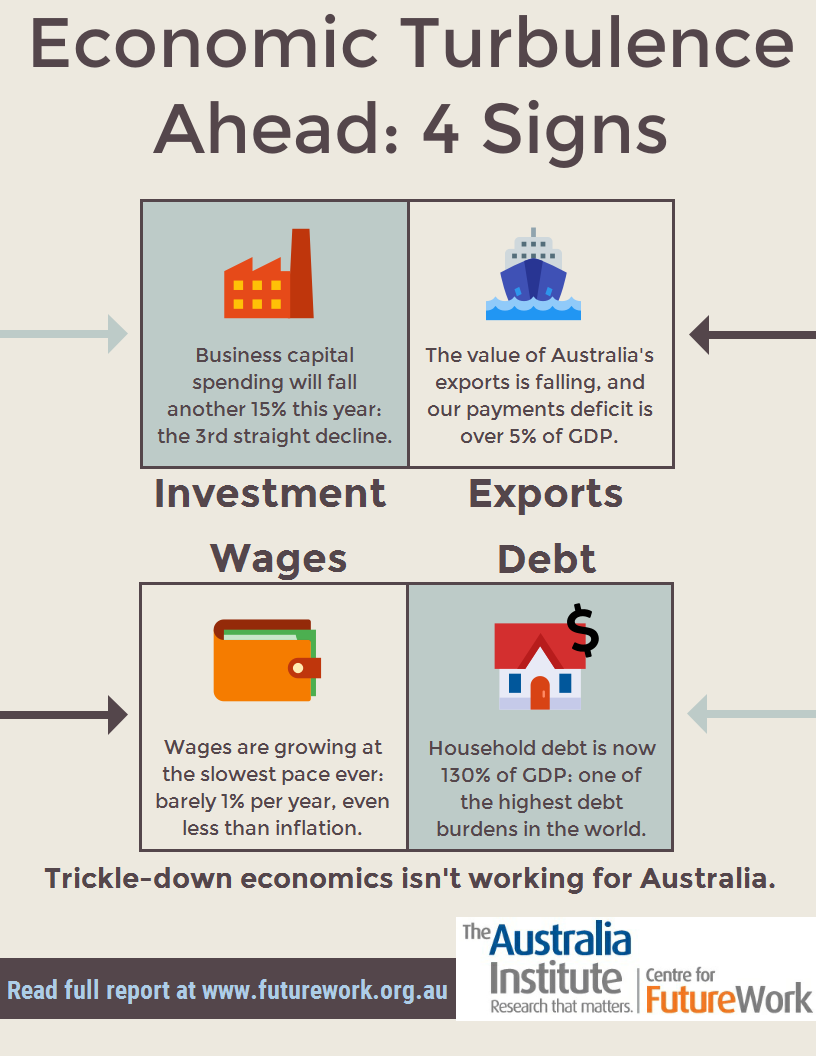
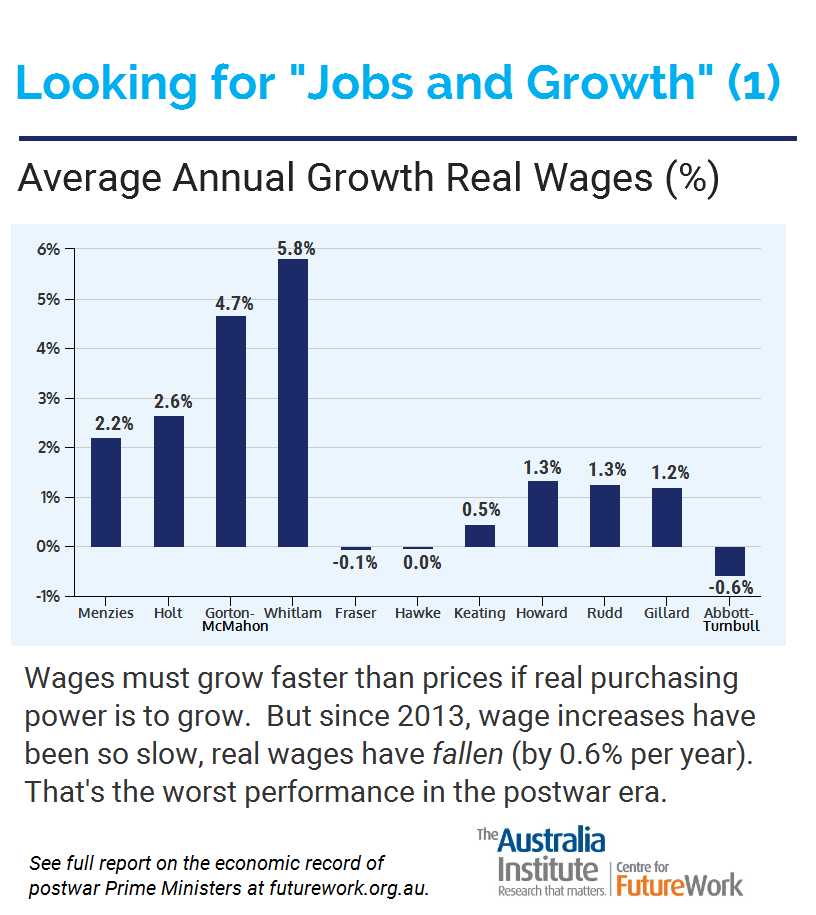
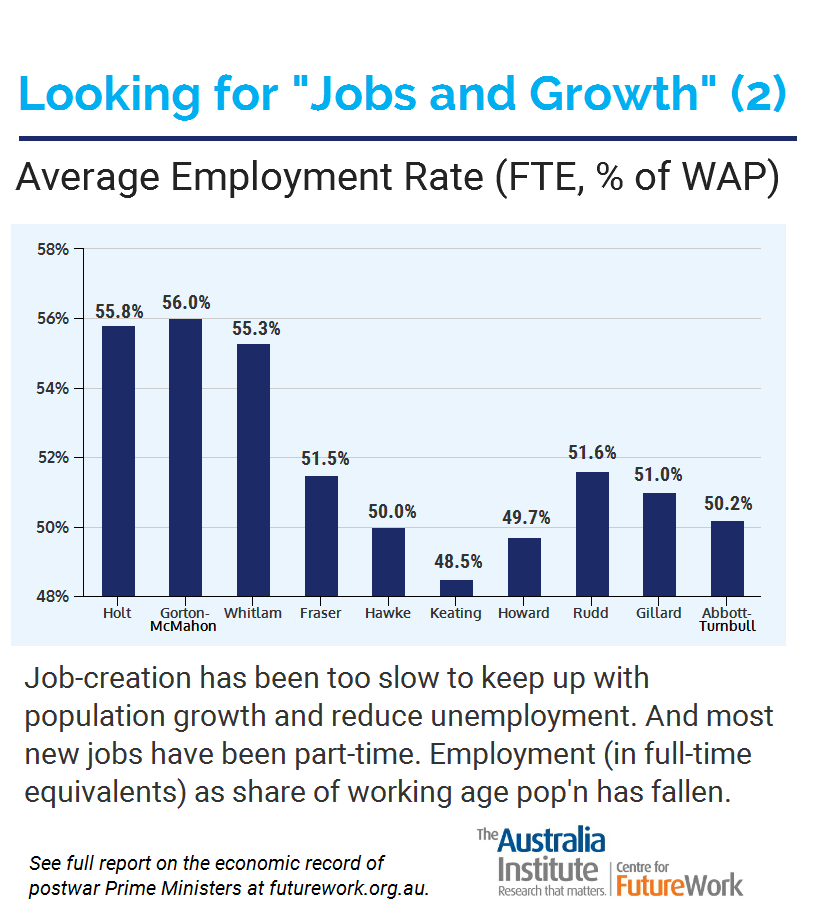
  • Looking for Jobs and Growth: Six Infographics

    The infographics summarize several of the specific economic variables considered in the full report, dating back to 1950 (and Prime Minister Menzies) in most cases.

    Average Annual Growth, Real Wages
    Average Employment Rate
    Growth in Personal Debt
    Average Annual Growth, Business Investment
    Public Sector Investment
    4 Signs of Turbulence Ahead

    The post Looking for “Jobs and Growth”: Six Infographics appeared first on The Australia Institute's Centre for Future Work.

  • Make other plans – Today is national Go Home On Time Day

    The Australia Institute has also published a report, 9 to 5.30, which provides new snapshot of unpaid overtime and the work life balance in Australia.

    This year Go Home On Time Day launched an Unpaid Overtime Calculator, which gives individuals a sense of how much unpaid overtime they’re doing.

    Thousands of Australians have already used the new Calculator App.

    “Increasingly, ‘work-life balance’ is more of an aspiration than a reality for many Australians,” Senior Economist at The Australia Institute, Matt Grudnoff said.

    “Australians now donate $128 billion in unpaid overtime annually to their employers.

    “Our data shows an increase in workers wanting to work less hours and a decrease in those looking for more. So there seems to be a growing desire for more leisure or family time in their work-life balance.

    Table 1: Overwork/underwork survey results (2015, 2013 and 2012)

    Year of survey Wants to work more hours Wants to work less hours
    2015 18% 33%
    2013 24% 28%
    2012 21% 26%

    Note: 2012 and 2013 are the years for which data is available

    The study also looked at ‘polluted time’ – where work bleeds into life. Smartphone, tablet and wireless technology continues to make drawing a line between work and personal time harder.

    “The pressure of always carrying your work with you in your pocket can compound stress and have negative effects on mental health and productivity.

    “Part of this year’s go home on time day is a call for employers to consider steps which will help their staff enjoy their weekend, such as disabling work email servers,” Grudnoff said.

    National Go Home on Time Day was launched by The Australia Institute in 2009 as a light hearted way to recognise that life doesn’t need to revolve around work and a balance between work and life is important.

    The post Make other plans – Today is national Go Home On Time Day appeared first on The Australia Institute's Centre for Future Work.