Author: Future Admin

  • Scare Tactics for Corporate Tax Cuts Do Not Stand Fact Checks

    “Trump tax cuts: Scott Morrison warns business will abandon Australia while we are at the beach” was the Sydney Morning Herald headline, reporting on the Coalition Government’s scare tactics to press through its tax cuts gift for business. The Treasurer used the opportunity of the Trump tax cuts to issue this “dire” warning. However, his claim does not withstand some basic empirical scrutiny.

    Fact 1: Australia is not a high tax country

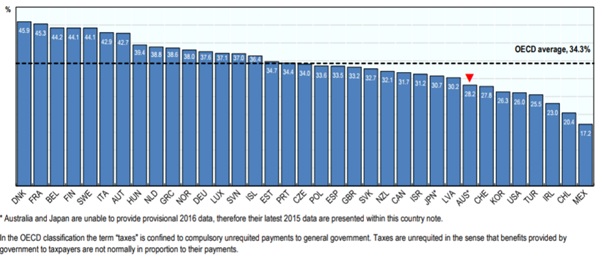
    Our overall tax take is one of the lowest among the 35 OECD countries. If Mr. Morrison was correct, then by now there should have been a tsunami of investment flowing here from 27 OECD countries with higher tax-GDP ratios than that of Australia’s 28.2% in 2016. Australia’s overall tax ratio is well below the OECD average of 34%, and also below neighbouring New Zealand’s tax take of 32.1% of GDP.

    Here are reported tax ratios for 27 OECD countries, 2016.

    OECD Tax Shares
    Source: Revenue Statistics 2017 – Australia; https://www.oecd.org/tax/revenue-statistics-australia.pdf

    Fact 2: Australia’s effective corporate tax is far below its statutory 30% rate

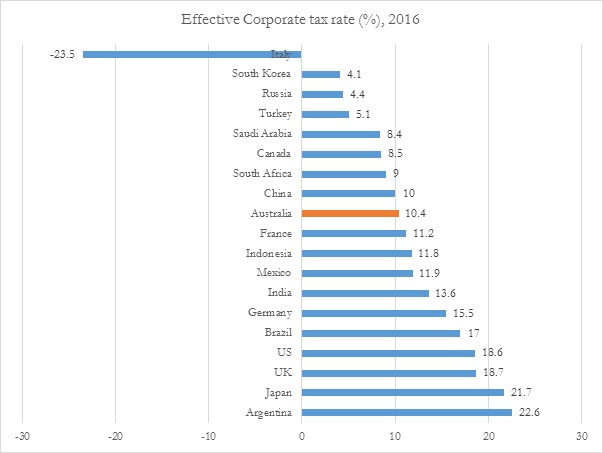
    Australian companies may seem to face a higher statutory corporate tax rate, but once they go through all their deductions and credits they don’t end up paying an unusually high amount compared to companies in other nations. The average effective rate (10.4%) is barely one-third the statutory rate. In fact, more than a third of large companies did not pay any corporate taxes in 2016 according to the recently released ATO data.

    Effective vs Statutory Tax Rates
    Source: National Public Radio, based on US Congressional Budget Office data; https://www.npr.org/2017/08/07/541797699/fact-check-does-the-u-s-have-the-highest-corporate-tax-rate-in-the-world

    Fact 3: Tax is low on companies’ lists of factors influencing investment location decision

    For example, the OECD noted, “it is not always clear that a tax reduction is required (or is able) to attract FDI. Where a higher corporate tax burden is matched by well-developed infrastructure, public services and other host country attributes attractive to business… tax competition from relatively low-tax countries not offering similar advantages may not seriously affect location choice. Indeed, a number of large OECD countries with relatively high effective tax rates are very successful in attracting FDI.”

    This is corroborated by the most recent World Bank survey of enterprises, which found that tax incentives are not high on the list of critical factors affecting inflows of foreign direct investment. The IMF’s recent research also reports that the net impact of corporate tax cuts to incentivise private investment is quite often negative on government revenues. The pre-tax profitability of Australian businesses has also tended to exceed that in other countries, and this is surely more important in motivating investment flows.

    Fact 4: Rigorous studies of past US tax cuts did not find a positive link between tax cuts and economic or employment growth

    For example, the oft-cited examples of the Reagan or Bush tax cuts do not in fact demonstrate that tax cuts cause growth. Admitted by President Reagan’s former chief economist, Martin Feldstein, the vast majority of growth during the Reagan era was due to expansionary monetary policy that slashed interest rates massively to help the economy bounce back from a severe recession in 1982. Increased defence spending and an expanded labour force due to an influx of baby boomers also boosted the economy. In another study with Doug Elmendorf, the former Congressional Budget Office Director, Martin Feldstein found no evidence that the 1981 tax cuts increased employment.

    The 2001 and 2003 Bush tax cuts also failed to spur growth. Between 2001 and 2007 the economy grew at a lacklustre pace—real per-capita income rose by 1.5% annually, compared to 2.3% over the 1950-2001 period. Interestingly, the two sectors that grew most rapidly in this period were housing and finance, which were not affected by the 2001 and 2003 tax cuts. Moreover, by 2006, prime-age males were working the same hours as in 2000 (before the tax cuts), and women were working less – both facts inconsistent with the view that lower tax rates raise labour supply.

    Fact 5: The most infamous case of tax cuts in the US State of Kansas was a colossal failure

    Governor Sam Brownback promised that a moderate tax cut for individuals and a big tax cut for businesses would be “like a shot of adrenaline into the heart of the Kansas economy.” Unfortunately, however, despite his 2012 tax cuts, the Kansas economy remained moribund, while neighbouring states surged ahead. In the process, the Kansas state budget was left in tatters. No wonder that the Republican-led state legislature reversed most of Brownback’s tax cuts in the face of poor growth and pressing public spending needs.

    Therefore, if Mr. Morrison is serious about repairing the budget, or stimulating growth and employment, then he should be concentrating on raising more revenues (not less) and investing in the nation – instead of cutting basic services to fund his tax cuts for the rich. He should be looking at the facts, instead of resorting to scare tactics.

    The post Scare Tactics for Corporate Tax Cuts Do Not Stand Fact Checks appeared first on The Australia Institute's Centre for Future Work.

  • Job Opportunity – Research Economist

    The successful candidate will offer:

    • A graduate degree in economics or a closely related discipline.
    • Knowledge of and experience with a wide range of labour issues, preferably including: labour market statistics and trends; characteristics and determinants of employment; industrial relations and collective bargaining; wage determination and inequality; gender, racial, and demographic aspects of labour markets; the impact of technology on employment; macroeconomic policy and labour markets; and others.
    • Demonstrated ability to write to deadline for professional and popular audiences in a credible, succinct, and accessible manner.
    • Strong quantitative skills, including ability to access statistical data, analyse it (including familiarity with statistical tools), and report it in a variety of textual, tabular and graphical formats.
    • Confident communication skills, including ability to speak to public audiences, classrooms, and the media.
    • Ability to work collegially with other members of a research team.
    • Commitment to a progressive vision of work and fairness, including the goals of equality, participation, collective representation and trade unionism.

    Responsibilities of the position will include:

    • Research and completion of several project-length research papers, briefing notes, and shorter commentary articles per year on a range of topics related to labour markets and labour market policy.
    • Ongoing monitoring and analysis of labour market data and information.
    • Helping to maintain relevant websites and databases.
    • Public speaking, presentations, lectures and courses, media interviews, and related communication and educational activities.
    • Minimal office and administrative functions.

    Ability to undertake occasional out-of-town travel (including overnight travel) is essential, as is ability to successfully work in a self-managed and autonomous manner.

    The position will be offered on a one-year term-limited basis, with possibility for renewal. Salary will be commensurate with qualifications and experience.

    Applications are especially invited from women, indigenous persons, other racial and linguistic communities, people with disabilities, and other marginalised communities.

    Please forward applications (including contact information, qualifications, experience, two samples of written work, and names and contact details for two references) in confidence to cfwjob@tai.org.au. Please cite “Economist Job Application” in the subject field of your message; supporting documents should be attached in pdf format. Receipt of applications will be acknowledged by e-mail. Only candidates selected for an interview will then be contacted; no phone calls please.

    Applications must be received by 5:00 pm AEDT on Wednesday 9 October, and interviews will be conducted in Sydney on Wednesday 23 October 2019.

    The Centre for Future Work is an initiative of the Australia Institute, Australia’s leading progressive research institution. Thank you for your interest in the Centre for Future Work.

    The post Job Opportunity: Research Economist appeared first on The Australia Institute's Centre for Future Work.

  • Job Growth No Guarantee of Wage Growth

    Job Growth No Guarantee of Wage Growth

    by Dr. Anis Chowdhury

    ‘Remarkable’ jobs growth raises hopes for wages” was the headline for a recent Sydney Morning Herald opinion piece by Clancy Yeates. He bases this claim on “some brighter news on the labour market to balance the bad: there is something of a jobs boom under way”. Apparently “more jobs have been created in 2017 in net terms than any year since 2005, with 371,000 new net jobs so far this year”. Clancy Yeates also points to “the lowest number of unemployed people per unfilled position since 2012”.

    This optimism is also shared by the Treasury Secretary John Fraser. In his opening statement at the recent Senate budget estimates hearing on 25 October, he said, “We expect that a period of stronger growth and falling unemployment will lift wages in the next few years.” He further noted, “We do expect that as the cyclical constraints that have weighed on the economy recede wages growth will accelerate.”

    The RBA also holds a similar optimistic view. Philip Lowe, the RBA Governor, in his September statement observed, “Employment growth has been stronger over recent months and has increased in all states. The various forward-looking indicators point to solid growth in employment over the period ahead. … stronger conditions in the labour market should see some lift in wages growth over time.” He had the same positive view in his October statement.

    But can we really be so confident that job growth will eventually lead to wage growth? And even if it does, would it be strong enough to catch up and compensate for the losses incurred from such a long period of wage stagnation?

    Unfortunately, the answer to these questions is a resounding ‘NO’. This so-called remarkable jobs growth will not result in an eventual wage growth sufficient to close the wages gap. This has been confirmed by the latest data showing wages rose by less than expected last quarter; even a significant mandated jump in the minimum wage failed to lift the rate of growth of workers’ pay across the economy. The most broad measure of average earnings growth (derived from GDP statistics) has actually turned negative – the weakest since the mid-1960s.

    The reason for this contradiction is very simple – it is rooted in the different nature of new and old jobs. Jobs, whether part-time or full-time, are now more insecure. Just consider some recent news. The NAB has announced 6,000 job cuts by 2020 even when it announced $6.6 billion profit! Earlier Telstraconfirmed 1,400 job cuts.

    Job insecurity is not just a phenomena in the private sector. Governments – State and Commonwealth – have also joined the new trend. For example, the NSW department of Finance Services and Innovation has notified the union representing the cleaners that employment guarantees in place since 1994 “will not be extended in the new contracts from 2018”.

    The optimists seemed to have decided to ignore what Alan Greenspan, the former chairman of the US Federal Reserve, said in his Congressional hearing two decades ago (on 26 February, 1997). Explaining why “the rate of pay increase still was markedly less than historical relationships with labor market conditions would have predicted”, he said: “Atypical restraint on compensation increases … appears to be mainly the consequence of greater worker insecurity.”

    He clearly elevated job insecurity to major status in the Fed’s policy analysis. Workers have been too worried about keeping their jobs to push for higher wages. And this has been sufficient to hold down inflation without the added restraint of higher interest rates.

    But Greenspan also implied that workers’ fear of losing their jobs was not in itself a sufficient explanation for their failure to push for significant wage increases. The sense of job insecurity has to be rising over time; that is, continually getting worse. Because once the level of insecurity leveled off, and workers become accustomed to their new level of uncertainty, their confidence may revive and the upward pressure on wages would resume. That is particularly true when the unemployment rate is low, as it is today (at least officially).

    However, looking at the length of contracts, Jeff Borland, a leading Australian labour economist, finds no evidence of increased job insecurity in Australia. Others have reported similar findings, while others cite different data to indicate a growth in insecurity. A new ABS survey also showed that while there had been an increase in the number of people with more than one job since 2010-11, those doing multiple jobs as a proportion of the workforce had remained almost completely unchanged at 6%.

    Job insecurity is notoriously difficult to measure. It is not the length of contracts or whether a job is full-time or part-time, that matters. It is the constant threat of losing jobs or pay conditions despite tenure due to constant restructuring that the workers fear. It is the news like that from the ice cream manufacturer Street wanting to terminate its enterprise agreement, or announcements like the one from the NSW department of Finance Services and Innovation, which generate the sense of job insecurity.

    It is this sense of job insecurity and fear of not finding a decent job after losing one (as experienced, for example, when Holden and Toyota recently closed down) which Alan Greenspan had in mind when he calibrated Fed’s monetary policy levers. Thus, there has to be continuous restructuring in the guise of addressing falling or stagnant productivity to keep lid on wages, while the real intent is creating fears among the working class.

    When nearly half the Australian families (41%) feel job security is chief among their concerns, this supposedly remarkable jobs growth won’t generate pressure for wage growth as hoped by the optimists. “Insecure, stressed, and underemployed: The daily reality for millions of Australians”, is how David Taylor summarised the labour market in Australia. This is experienced even as profits are growing at their highest rate in two decades.

    Governments – State and Federal – should worry about rising job insecurity, instead of adding fuel to the fire with their own employment restructuring initiatives. The high level of job insecurity doesn’t just have an effect on wage growth and inflation. Recent research has found that it “cuts to the core of identity and social stability – and can push people towards extremism”. We all have a stake in creating more secure jobs, and fairly rewarding those who perform them.

    The post Job Growth No Guarantee of Wage Growth appeared first on The Australia Institute's Centre for Future Work.

  • The Paradox of Rising Underemployment and Growing Hours

    Paradoxically, underemployment and number of hours actually worked are both on the rise in Australia.

    Since 1978 from when the ABS started publishing data on the number of hours worked per month, the hours increased continuously. For example, in July 1978 slightly less than a billion hours was worked; the figure was 1.7 billion in June 2017 – a rise of 781.9 million hours worked a month. Compared with June 2008, 151.3 million more hours were worked in June 2017. The recently released Labour Account Australia, Experimental Estimates, July 2017 (by ABS) shows that between 2010/11 and 2015/16, hours actually worked increased by 5.7% from 19.15 billion hours to 20.23 billion hours.

    The rising number of hours worked should be a good news, provided it meant more income. But for the most part during this period real wages either stagnated or fell. Recent ABS data show that quarterly real wage growth stuck below 0.6% for three years, translating into an annual wage growth of just 1.9%, the lowest figure since the late 1990s, and probably the slowest rate of pay rises since the last recession.

    Hence the majority of workers are forced to work more hours in their struggle to maintain a decent living. Labour Account Australia, Experimental Estimates (July 2017) records that a good number of people work more than one job. Interestingly, increasing by 64,100 (9.2%), the growth in secondary jobs outstripped the growth in main jobs which increased by 791,700 (6.8%) over the six years to June 2016.

    It is also not surprising that people are wanting to work more hours, raising the incidence of involuntary underemployment. The most recent ABS estimate, for May 2017, shows 1.129 million Australians working fewer hours than they would like. This translates into an underemployment rate of 9.3%. When added to the current headline unemployment rate of 5.6%, we have a whopping “underutilisation” rate of around 14.9%!

    Labour exploitation is also on the rise as the unpaid overtime work gets longer. The Australia Institute’s 2016 survey (Excessive Hours and Unpaid Overtime: An Update) found that full-time workers were on average performing more than 5.1 hours a week in unpaid overtime. Part-time and casual employees work an average of 3.74 hours unpaid overtime per week. For full-time workers, average unpaid overtime is worth over $10,000 per year – or 13% of actual earnings. For part-time workers, lost income from unpaid overtime exceeds $7500 per year, and represents an even larger share (nearly 25%) of actual earnings. The lost income due to unpaid overtime represents a significant loss to workers and their families.

    Australians are putting in some of the longest hours (more than 50 hours) in the developed world, coming in 9th in a survey of OECD countries. Full-time employees are on average putting in extra 4.28 hours and part-time staff are working an hour over their contracted hours every week. ABS data show that around 30% of employed men and 11% of employed women report usual working 45 hours or more each week.

    Thus, Australian workers are over-worked and underpaid. They are both time and income poor.

    These paradoxes are not statistical quirks. They are the results of heightened job insecurity; but it is deliberate! It is caused by changes in the labour market institutions governing wage and employment conditions, designed to increase the share of profit and strengthen corporate power.

    Alan Greenspan, the former Chairman of the US Federal Reserve, made this very clear in his testimony to the Congress two decades ago (26 February, 1997). He elevated job insecurity to major status in central bank policy when he said, “Certainly other factors have contributed to ‘the softness in compensation growth” despite a low unemployment rate, but ”I would be surprised if they were nearly as important as job insecurity”.

    Workers have been too worried about keeping their jobs to push for higher wages, and this has been sufficient to hold down inflation without the added restraint of higher interest rates. He also acknowledged, “Owing in part to this subdued behavior of unit [labour] costs, profits and rates of return on capital have risen to high levels”.

    Most interestingly, according to Greenspan, widely regarded as the “guru” of present day monetary policy-makers, workers’ fear of losing jobs is not in itself sufficient; the sense of job insecurity has to be rising or getting worse to prevent any push for significant wage increases. This is because, once it levels off, and workers become accustomed to their new level of uncertainty, their confidence may revive and the upward pressure on wages resume, especially when more people find jobs and the unemployment rate drops.

    Right now, millions of Australians are feeling some level of job insecurity because of increased casualisation of employment and insufficient availability of full-time regular jobs. The increase in casual and non-permanent work is putting pressure on people to work harder for longer, and to work more hours unpaid.

    There are many reasons, from automation to slower growth of the economy, for increased job insecurity. But one factor contributed the most – the deregulation of the labour market in the name of increased flexibility. This not only involved moves from centralised to enterprise bargaining and to individual contracts, but also restrictions on union activities – both intended to weaken worker’s bargaining power and strengthen business’s hiring and firing power.

    One can easily blame successive Liberal-National Coalition Governments, starting from John Howard for this. But the Hawke-Keating Labor Government started the process, arguing that it was necessary to respond to changing global economic conditions and to remain competitive. The Hawke-Keating Government argued that linking wage bargaining to the enterprise performance would provide flexibility and hence boost productivity.

    The succeeding Howard-Costello Government increased so-called flexibility by introducing “work choices” (individual contracts) arguing the same. In 2007, Peter Costello said that the greatest risk to Australia’s prosperity is a return to centralised wage fixing: “Nothing could be a bigger threat to the Australian economy at the moment than moving away from decentralised wage fixation and going back to the past.”

    But alas; there has been no sustained boost in productivity growth. Instead, successive labour market reforms have allowed inefficient enterprises to survive. Employers  felt no pressure to upgrade technology, improve management practices or train workers to boost productivity, as both Labor and Coalition Governments, held hostage by the business group threatening to leave Australia for cheaper destinations, vied with each other to make Australia more hospitable – more “competitive” – for businesses by making labour cheaper and regulations looser.

    During 2016, Australia’s labour productivity growth was nil whereas it grew by 1.9% in OECD. Only 4 other OECD countries experienced lower productivity growth than Australia. Using the internationally comparable US Conference Board data, the Productivity Commission reported that Australia’s multi-factor productivity (MFP) growth in 2014 was negative (-0.9%) – and lower than China, India and Korea. MFP reflects the overall efficiency with which labour and capital inputs are used together in the production process. MFP growth in Australia continued to decline since the mid-1990s reaching a negative figure, i.e., declining during 2005-2010.

    The problem is well exemplified by Australia’s auto industry which survived only due to the life-line of government subsidies and some industry protection – recall the Rudd Labor Government’s $6.2 billion over the next 13 years and Abbott Government’s $900 million budget backdown. Despite all the flexibilities afforded by diluting the employment and pay conditions, one of just 13 countries in the world capable of building a car from the ground up, Australia’s 90-year history of assembling and building automobiles is coming to an end with the pulling off of the plug of government assistance.

    Therefore, the only way Australia can now compete internationally is by racing to the bottom; by lowering labour cost – cutting the penalty rates, lowering the minimum wage and diluting working conditions; in short, by underpaying the workers and forcing them to work longer hours. And this only can succeed by ensuring continued rise in job insecurity though underemployment, more spells of unemployment, more volatility in the hours the workers are expected to work and continued weakening of labour’s bargaining power.

    The post The Paradox of Rising Underemployment and Growing Hours appeared first on The Australia Institute's Centre for Future Work.

  • Dogged manufacturing sector quietly adds 40,000 jobs

    The report, A Moment of Opportunity (download full report pdf below), identifies several indicators which suggest that the economic opportunities for domestic manufacturing have improved significantly.

    The Centre for Future Work in The Australia Institute will host the National Manufacturing Summit: From Opportunity to Action at Parliament House on Wednesday 21 June 2017. Speakers will include a wide range of experts from industry, university, trade union, and financial sectors, as well as four top political spokespersons: Minister for Industry Senator Arthur Sinodinos, Shadow Minister for Industry Senator Kim Carr, Greens Industry spokesperson Senator Lee Rhiannon, and NXT leader Senator Nick Xenophon.

    “Australia’s manufacturing industry faces some daunting domestic and global challenges. But it’s not just surviving, it’s finding a way to grow, adding 40,000 new jobs last year,” Director of the Centre for Future Work, Dr Jim Stanford said.

    “That ranks manufacturing as the second biggest source of new jobs in Australia last year.”

    “Additionally, manufacturing re-invests 5% of its value added in R&D, the highest of any industry, making it an engine room for innovation in the economy.”

    New polling released as part of the report shows that Australians are very supportive of pro-active, targeted policy measures to sustain and support manufacturing (see polling results below).

    “Perhaps influenced by the negative tone of much recent commentary, Australians consistently underestimate the size of manufacturing in Australia’s economy, relative to other industries, but nonetheless recognise the value of maintaining a strong manufacturing sector.

    Specifically, there was strong support for targeted policies such as government procurement mandates (81%) and tax incentives tied to investments in domestic facilities (79%); support was strong across all age and voting groups. Australians opposed measures to attract industry by cutting wages, environmental standards, or across-the-board taxes. But measures focused on manufacturing, tied to Australian production and jobs, received overwhelming support – by a margin of up to five-to-one.

    “Both economically and politically, the smart move would be for legislators to get behind local manufacturing with targeted policies to support Australian jobs, ” Stanford said.

    The post Dogged manufacturing sector quietly adds 40,000 jobs appeared first on The Australia Institute's Centre for Future Work.

  • Budget Wrap-Up

    Wage Growth and Deficit Reduction

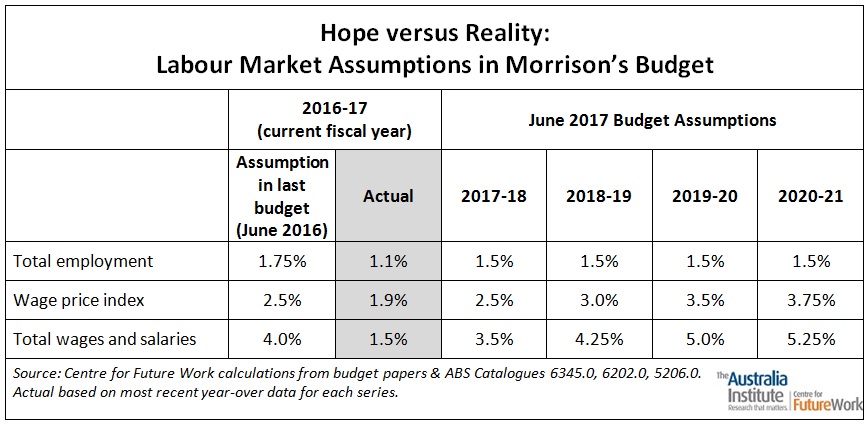
    Several commentators have highlighted the budget’s highly optimistic assumptions regarding future job-creation and wage growth incorporated into the budget forecast. The government is anticipating an immediate and sustained acceleration of all of the factors that contribute to the wage base for tax revenue: faster job-creation, significantly faster growth in hourly pay, and dramatically faster growth in total wages and salaries.

    Back in the real world, the labour market has been underperforming on ALL THREE of those components: slow job-growth, record slow growth in hourly wages, and falling weekly hours of work (due to the dramatic expansion of part-time and irregular work). For all of these reasons, total wages and salaries paid out in the economy (which forms the major basis for personal tax collections, both income and GST) actually declined in the latest quarter of GDP (Dec 2016).
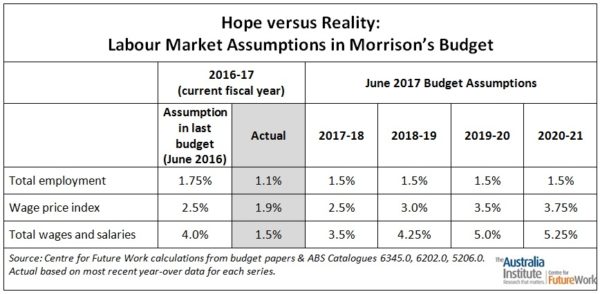
    This table summarises the main wage assumptions in Mr. Morrison’s budget, contrasting them to the latest actual figures on each of the three criteria. The last budget (2016-17) missed the mark badly on all three criteria — but the likely undershooting error will be huge by the end of this budget’s forward estimates, unless there is a dramatic and sustained acceleration of employment and wages growth.

    Director Jim Stanford pointed out in this Huffington Post column that the current weakness in Australian wages is not an accident, nor is it likely to reverse automatically. Chronically weak aggregate labour market conditions, combined with structural attacks on the institutions that support wages (including unions, minimum wages, penalty rates, and others), have caused the unprecedented stagnation of wage incomes in Australia. The macroeconomic consequences of this state of affairs have been widely acknowledged — even by the government itself. (Mr. Morrison himself spoke recently of his concern with the impact of wage stagnation on his own budget targets.)

    As Stanford put it in his Huffington Post commentary, the contradiction between the government’s wage-suppressing economic and regulatory policies, and its hope that wage growth will nevertheless power the way to a balanced budget, is both glaring and unsustainable:

    “[Morrison’s] rose-coloured labour market assumptions will be sabotaged by his own government’s continuing war on workers and wages. And that’s one important reason why his hopeful deficit targets will not be realised.”

    General Optimism Regarding Revenue

    The budget’s optimistic wage growth assumptions are just one factor behind an overall revenue forecast that is downright ebullient. The main force behind the projected return to a balanced budget is an enormous assumed increase in tax revenues — very ironic coming from a government that regularly derides the alleged “tax-and-spend” procilivities of its opponents. Over the four years of the forward projection, annual revenues are expected to expand $120 billion by 2020-21 (or 30 percent). As a share of GDP, revenues are expected to swell by 2.2 percentage points, reaching the highest share (25.4% of GDP) since the peak of the mining boom (in 2005-06).

    There is no clear explanation of where these huge new revenues come from – especially given the revenue-reducing effect of other budget measures, including company tax cuts, the elimination of the deficit repair levy for high-income earners, last year’s bracket adjustments, and others. There are some modest revenue measures in the budget: including the 0.5% Medicare levy increase (after 2019), the levy on bank liabilities, and a new levy on employers who hire migrant labour. But those policy decisions account for just 6.5% of all new revenues assumed to be received over the coming 4 years — and they will be more than offset by the revenue losses from the other measures (especially the company tax cuts).

    If revenues stay constant as a share of GDP (instead of magically growing), the budget will be $45 billion short in 2020-21 – and the forecast small surplus will evaporate into a large continuing deficit. Indeed, as our colleagues at the Australia Institute have pointed out, this budget marks the fourth consecutive four-year LNP timetable for balancing the budget. The government’s tough talk on the dangers of deficit-financing, and stated intention to quickly achieve balance, have proven hollow. Many of its proposed spending cutbacks have been successfully resisted by community campaigning. And its rosy revenue forecasts have been consistently unfounded. There is no reason to believe this year’s four-year deficit elimination timetable is any more realistic than the last three.

    Robbing Peter to Pay Paul

    On the spending side, the government is announcing some modest new spending initiatives, totaling $9 billion over 4 years.

    But at the same time, they are announcing spending cuts to a wide range of programs (including higher education, welfare, and civil servants) – totaling $10 billion over the same period.

    The net impact of new policy decisions on spending is therefore $1 billion in the negative. Despite the promise of “better times” in the future, the government’s discretionary actions will reduce aggregate funding for the programs that Australians depend on.

    A Target Everyone Can Love: The Big Banks

    The government’s new 6 basis point “levy” on bank liabilities (ie. on outstanding loans) is forecast to raise $6.2 billion over 4 years.

    Many analysts believe this tax will be passed on to borrowers (since it is defined as a proportion of lending), and the government has not provided a convincing refutation of this concern. The levy is equivalent to a slight increase in the cost of capital for new lending. (In fact, this new “levy” is smaller than recent increases in interest rates which the banks have already passed on to their borrowers.)

    The government’s claim that the ACCC, with increased funding, will ensure the banks do not pass on the costs of the levy is laughable — as is its claims that competition from smaller banks will keep the big banks in line. Unless there is outright collusion and price-setting between the banks (something that is rare and unnecessary anyway), there is nothing illegal about passing on higher costs to consumers. Indeed, the ability to do this is precisely what explains the banks’ consistent above-normal profits (earning return on equity of 15 percent or more each and every year).

    At any rate, once the banks start to benefit from the full 5% reduction in their own corporate taxes (by 2026-27), they will still be saving billions each year on a net basis.

    The eminent economist Prof. Geoffrey Harcourt, a good friend of our Centre, put it this way in a blog comment:

    “The discussions on the levy/tax on the big four banks in the 2017 budget are often hysterical and beside the point. Because banks play an essential role in the running of the economy, they need protection through a guarantee from the government. Because of their oligopolistic market structure, they are in a privileged position to make large profits, a portion of which reflects their necessary privileged position, rather than any merit of their own. Common sense suggests that it would be both efficient and equitable that the banks be allowed to receive, say, the average rate of profits ruling in the economy as a whole without being taxed differently than any other form of enterprise in Australia. If their overall rates of profit are greater than the average – which they certainly are – the differences between the two sets of rates should be subject to a higher rate of tax so that the community at large receives a return on the privileged position the banks have been necessarily granted. The proposed levy is roughly akin to this proposal, which is tackling an equitable puzzle. It should not, in principle, be related to what is happening to the budget overall and especially to the sizes of any deficits or surpluses. These should reflect the outcome of attempting to meet the real aims of good government starting with achieving and sustaining full employment and sustainable growth.”

    Infrastructure Spending: Show Us the Money

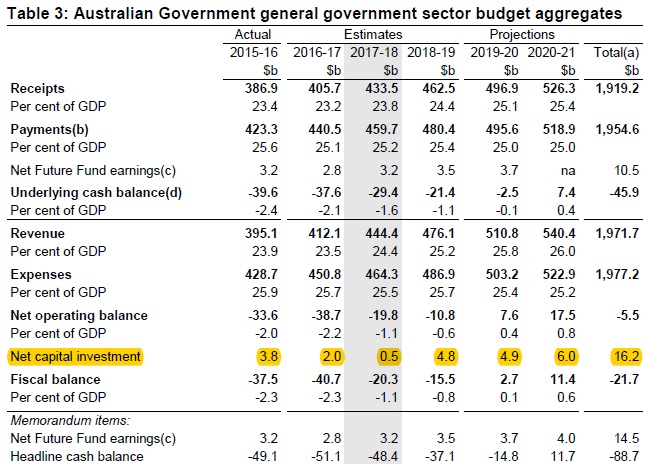
    The government is boasting of $75 billion in infrastructure funding and financing over the next ten years. It is impossible to know how much of this represents new funds, nor when the funds would be delivered. Keep in mind that at present the government already spends over $18 billion per year on capital (or $200 billion over the next decade): both on new projects, and offsetting the wear and tear of existing assets. So the $75 billion “plan” ($7.5 billion per year) may or may not represent a substantial ramp-up in new capital spending by Canberra.

    In fact, the details of the budget do not seem to indicate any enormous expansion in capital spending. Net capital spending (after depreciation) is projected to decline in 2017-18: to just $0.5 billion, the smallest since 2002-03. (See Budget Table 3, reprinted below.) In essence, in the first year of the budget, the government will spend barely enough to offset depreciation of existing assets.
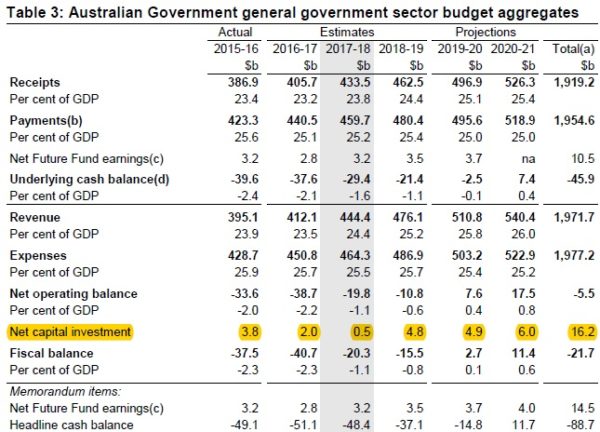
    Net investment grows in later years, but not dramatically. And as a share of GDP, net capital spending by the Commonwealth is projected to average just 0.2% of GDP over the forward projections. Over the last ten years, in contrast, it averaged 0.25% of GDP. In other words, under this budget, net Commonwealth capital spending will actually shrink relative to the economy.

    It is easy to come up with “big numbers” when talking about infrastructure programs (especially by summing totals over many years), and associated ribbon-cutting ceremonies will attract much attention. But there is no concrete evidence that this budget will accomplish the real and sustained increase in Commonwealth government capital spending that is needed. Commonwealth capital spending has declined in recent years compared to earlier decades, and there is no evidence that this budget will change that trend.

    Migrant Labour and Apprentices

    The government is imposing a new “head tax” on employers who hire foreign migrants: $1200 to $1800 per year per head for temporary migrants, and $3000 to $5000 for each permanent migrant (on a one-time basis). The revenues from this levy will be used to fund support for apprenticeships in conjunction with the states, to a total of $1.2 billion over the next 4 years.

    Funding skill programs through a tax on migrant labour is not an effective way to rebuild Australia’s battered vocational education system – nor is it an effective way to regulate employers’ over-reliance on temporary foreign migrants (rather than recruiting and training Australian workers). Indeed, the scale of revenues anticipated by the government suggests that incoming migrant labour will continue to constitute a major force in Australia’s labour market.

    Effectively regulating and reforming Australia’s migrant labour system – limiting its use to classifications where skilled workers are truly unavailable, and ensuring that migrant workers are entitled to the same protections as all other workers – would in fact undermine the head tax revenues that the government is now counting on.

    Check Out The Australia Institute’s Budget Analysis

    Our colleagues at the Australia Institute have also generated some useful and punchy commentary on the budget: see it all (including a hilarious podcast with economists Richard Denniss and Matt Grudnoff) on the Institute’s Budget Wrap page.

    The post Budget Wrap-Up appeared first on The Australia Institute's Centre for Future Work.
  • Economists Debunk Job-Creation Claims of Penalty Rate Cut

    A 3-person drafting committee wrote the letter and circulated it among the economics community. The committee included Stephen Koukoulas (Managing Director of Market Economics), John Quiggin (Dept. of Economics, University of Queensland), and our own Jim Stanford (Economist and Director of the Centre for Future Work). See the full letter, and list of signatories, below.

    The post Economists Debunk Job-Creation Claims of Penalty Rate Cut appeared first on The Australia Institute's Centre for Future Work.
  • Don’t Pop Champagne Corks Over Longest Growth Streak

    In this guest commentary, Prof. Anis Chowdhury – a new Associate of the Centre for Future Work, and a distinguished global economist – provides some important perspective on this longest expansion in history.

    Little to Rejoice About in Australia’s Record-Long Expansion

    by Anis Chowdhury

    On April 1, Australia will overtake the Netherlands to lay claim to the title of the longest economic expansion on record, entering our 104th quarter of economic growth, as the nation narrowly avoided slipping into a technical recession.

    With the release of the GDP figure on 1 March, the government expressed a sigh of relief. It showed that Australia’s economy grew by 1.1 per cent in the last quarter, after slipping 0.5 per cent in the three months to December 1.

    Should we rejoice at this?

    It seems, Treasurer Scott Morrison thinks so. As the government is breathing easy, the Treasurer responded by saying “Our growth continues to be above the OECD average and confirms the successful change that is taking place in our economy as we move from the largest resources investment boom in our history to broader-based growth.”

    To be fair, the Treasurer was also cautious and acknowledged that nation’s economic growth “cannot be taken for granted and is not being experienced by all Australians in all parts of the country in the same way”.

    However, with this cautionary note the Treasurer has contradicted himself. If the nation’s growth cannot be guaranteed; if all Australians in all parts of the country are not sharing the benefit of this longest stint of growth, then it is simply not broad-based; nor is it inclusive.

    The nation’s growth still comes largely from mining, agriculture, forestry and fishing, as its manufacturing sector continues to shrink. The share of manufacturing in GDP now stands at around 6 per cent which is less than half what was four decades ago. Despite the longest growth stint, Australia still remains a primary-producing, two-speed economy.

    Australia’s terms of trade — the ratio of the nation’s export prices to its import prices — grew by 9.1 per cent, thanks to strong price rises in coal and iron ore, marking a 15.6 per cent improvement on the December 2015 quarter.

    Thus, Australia’s economic growth continues to be driven by commodity price booms, behind which is the economic expansion in emerging Asian economies, mainly China and India. If these economies sneeze, Australia will catch a cold. Hence, the Treasurer is correct, the “nation’s growth cannot be guaranteed”; it cannot be sustained.

    Even if it is sustained, it is not sustainable in the sense of ensuring social stability and protecting the environment. Australia’s current development trajectory is unlikely to achieve the Agenda 2030, the most ambitious and transformative goals for sustainable development adopted by the nations of the world in September 2015 at the United Nations.

    Let us reflect on some key indicators. First, Australia’s official unemployment rate edges up to 5.9 per cent in February, from 5.7 per cent in January, while underemployment skyrocketed to 1.1 million. The staggering underemployment is more a structural problem than a result of cyclical phenomena. The rise in unemployment and underemployment happened, even when we were told that labour market flexibility would boost employment – the main argument put forward in supporting recent cuts in penalty rates.

    Second, even without the penalty rate cuts, wages growth has been stagnant. The 1.1 per cent GDP growth that technically saved the economy from a recession, was accompanied by falling employee compensations by 0.5 per cent.

    Thus, the 0.9 per cent increase in household consumption, contributing 0.5 per cent to growth, which according to the Treasurer, was a key factor in bolstering the post-mining boom economy, seems to have been debt-driven. No wonder, Australia’s household debt at close to 125 per cent of GDP, is now the third highest in the world. At 187 per cent of household income, the RBA’s worries about household debts are not unfounded.

    Third, the divide between rich and poor is growing in Australia, according to a new national survey, which found more than a quarter of households have experienced a drop in income. At the same time, the socio-economic conditions of indigenous Australians remains shamefully at the Third World level. They don’t live as long as other Australians. Their children are more likely to die as infants. And their health, education and employment outcomes are worse than non-Indigenous people. Despite promising to close this gap on health, education and employment, the 2017 “Closing the Gap” report card finds that we are failing on six out of seven key measures. With less than year until the first wave of “Closing the Gap” deadlines, the road to reducing Indigenous disadvantage appears ever longer.

    Fourth, the latest Australia’s Environment Report 2016 reveals that Australia’s biodiversity is under increased threat and has, overall, continued to decline. It also reveals that pressures on the environment has increased from coalmining and the coal-seam gas industry, habitat fragmentation and degradation, invasive species, litter in our coastal and marine environments, and greater traffic volumes in our capital cities.

    While the quality of growth and overall socio-economic well-being continue to regress, what is the response from government? Regrettably, it is the same mantra: “repair the budget”; “cut welfare expenditure”; “cut wages and employment conditions”; “cut company tax”; “cut environmental regulation”, etc.

    Why these cuts? Because they will help keep our triple A credit rating! In the words of the Treasurer, “We must take the necessary steps to keep expenditure under control structurally, to boost investment, to maintain the AAA credit rating…”

    That is a huge leap of faith in the face of contrary findings world-wide, including Australia, that these sorts of measures do not boost investment; they do not fix the structural problems in the economy; they do not close the societal divide (between the rich and the poor, between indigenous peoples and the rest of Australia); and they do not protect our biodiversity or mitigate pressure on our environment.

    Public policies for structural transformation and environmentally sound, inclusive growth are for the brave hearts, not for the meek who remain hostage to the unaccountable credit rating agencies.

    The post Don’t Pop Champagne Corks Over Longest Growth Streak appeared first on The Australia Institute's Centre for Future Work.
  • Pain of penalty rate cuts can not be avoided through transition measures

    Analysis from The Australia Institute’s Centre for Future Work has shown that proposals for phasing in lower penalty rates for work on Sundays and holidays will not “protect” the workers affected by those cuts, and in some cases would make things worse.

    Simulations of various proposals from political and business leaders for deferring lower penalty rates, making offsetting adjustments in base wages, and/or “grandfathering” the wages of people already employed in the sector, suggest that none are capable of truly avoiding the resulting hardship.

    “Taking several years to implement a painful, damaging policy does not erase the impacts of that policy,” said Jim Stanford, Economist and Director of The Centre for Future Work, and the report’s author.

    “There appears to be a lack of understanding by some as to how much Sunday and holiday wages will fall under these proposals. A wage cut of that scale can’t be disguised simply by introducing it in stages.”

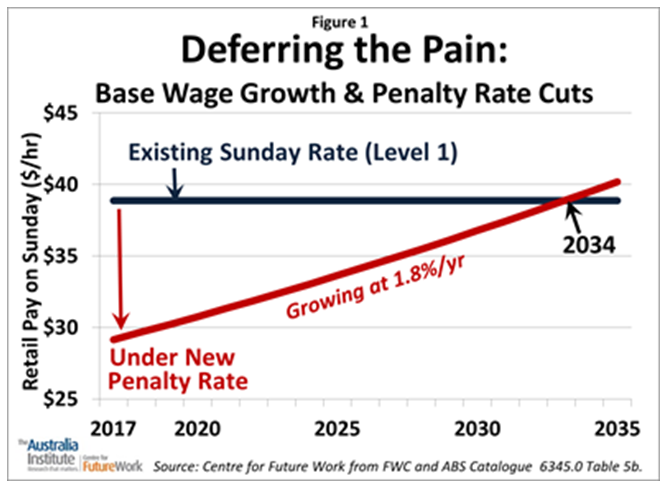
    The Centre’s report investigates the Prime Minister’s suggestion that penalty rate cuts could be “offset” by the impact of normal wage increases over time. At current rates of wage growth, it would take 17 years until higher base wages for retail workers fully offset the effect of lower penalty rates on nominal incomes.

    CFW Pen rate

    Making matters worse, ongoing inflation during those 17 years would reduce the real purchasing power of wages by 22 percent: almost equal to the reduction in Sunday pay proposed.

    Another transition proposal is to lift the minimum wage for retail and hospitality workers – either gradually or all at once. The report shows that this would substantially increase weighted average labour costs across retail and hospitality sectors by up to 25 percent (since the higher base wage must be paid to workers on other days of the week, too). This approach would be fiercely resisted by retail and hospitality employers.

    “Grandfathering” wages of existing retail and hospitality workers is also not feasible, largely because employers can easily reschedule existing workers to other days of the week, or even end their employment altogether.

    “The reduction in penalty rates for retail and hospitality workers will have a significant, negative impact on hundreds of thousands of employees, who are already among Australia’s most low-paid, insecure workers.

    “It is impossible to imagine a phase-in system to protect their compensation, when the whole point of this decision is to reduce it,” Stanford said.

    Stanford noted that lower penalty rates will exacerbate the problem of wage stagnation, which he argues is a more serious threat to growth and job-creation in Australia than penalty rates.

    The post Pain of penalty rate cuts can not be avoided through transition measures appeared first on The Australia Institute's Centre for Future Work.
  • Cutting penalty rates will reinforce wage stagnation

    The Fair Work Commission’s decision to reduce penalty rates for Sundays and holidays in retail and hospitality jobs will reinforce wage stagnation and further widen income inequality, which is bad news for the economy as a whole, according to Dr. Jim Stanford, Director of the Centre for Future Work at the Australia Institute.

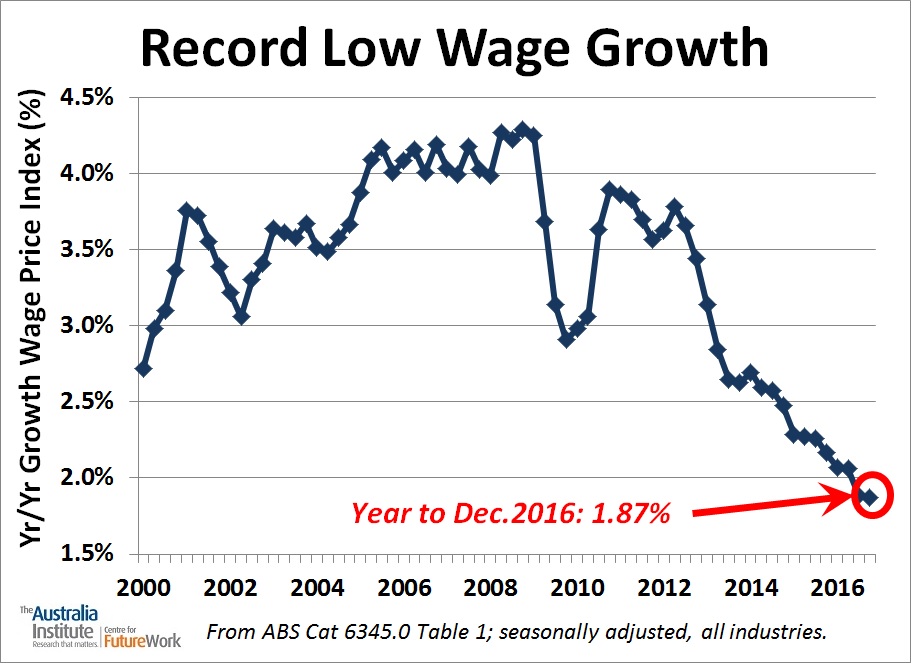
    “It’s painfully ironic that the Fair Work Commission’s decision was released just a day after the ABS confirmed the pace of Australian wages had already slowed to the worst in the history of their data,” Dr. Stanford said.

    “With household incomes going nowhere, and the economy slowing accordingly, now is the time to support the wages of low-income workers, not suppress them further.”

    “The economic argument that business will open longer, creating jobs has no basis. It will simply spread limited demand, and therefore jobs, over a longer period without increased employment.”

    ABS data released on Wednesday showed annual wage increases in the year to December 2016 fell to just 1.87 percent. Wages in retail and hospitality already lag far behind economy-wide averages, and part-time and casual jobs are the norm.

    Record low wage growth

    “Worse yet, workers in these sectors also face widespread wage fraud and violation of minimum wage laws, as documented at employers like 7-11 stores and Domino’s Pizza.”

    “By cutting Sunday and holiday penalty rates to as low as 125 percent, the Commission’s decision will significantly damage incomes for workers who already face precarious schedules and incomes.”

    Dr. Stanford was especially critical of claims that lower weekend wages will spur new job-creation in retail and hospitality.

    “It is elementary economics that employment in service sectors like retail and restaurants is constrained by the level of consumer demand, not by the level of wages.”

    “Lower wages will not lead to lower prices, they cannot boost consumer spending, and they will not create new jobs. In fact, by further suppressing labour incomes, this decision will undermine economic growth and job-creation even further.”

    “The idea that more businesses will open up on a Sunday and this will lead to more employment is also flawed logic. Since total demand will remain unchanged, a business will simply sell the same amount over 7 days instead of 6 days,” Stanford said.

    Read our previous polling of public attitudes to cutting penalty rates.

    The post Cutting penalty rates will reinforce wage stagnation appeared first on The Australia Institute's Centre for Future Work.