Our Centre continues to develop resources documenting the dimensions and causes of declining real wages, and countering the claim that trying to protect real living standards (by boosting wages at least as fast as inflation) will somehow cause hyperinflation and economic ruin.
Our new landmark report, The Wages Crisis: Revisited, provides comprehensive data on the scale of Australia’s wage slowdown – which began in earnest around 2013. Even after the dramatic events of the COVID-19 pandemic, and the surprising decline in the official unemployment rate (now slightly below 4%), wage growth has only regained the same sluggish pace demonstrated for several years before COVID. And with consumer price inflation accelerating, weak nominal wage growth is now corresponding to major erosion in real wages.
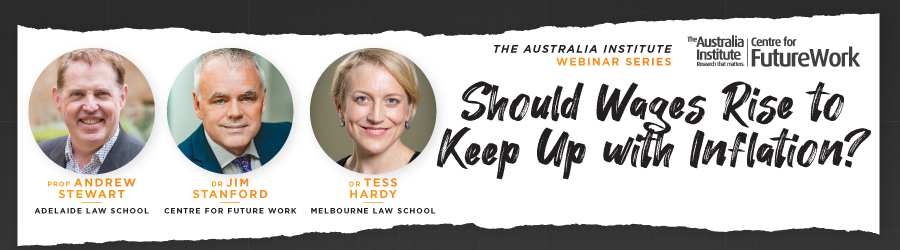
The three authors of that report – Prof Andrew Stewart from the Adelaide Law School, Assoc Prof Tess Hardy from Melbourne Law School, and the Centre for Future Work’s Director Jim Stanford – participated in a webinar hosted by our colleagues at the Australia Institute. They reviewed the main findings of the report, and answered several questions from the audience about the wages crisis and possible solutions. The webinar was hosted by Ebony Bennett, Deputy Director of the Australia Institute.
Our team has also been working to analyse the implications of the latest wages data for real incomes, macroeconomic performance – and the federal election, in which wages have emerged as a major point of contention. Please see the following analysis from our team:
- Proof positive. Real wages are shrinking, Wednesday’s figures put it beyond doubt, by Jim Stanford (Economist and Director), in The Conversation.
- Australian wages in real terms are essentially no different from where they were in 2013, by Greg Jericho (Policy Director, Labour Market and Fiscal), in The Guardian.
- WPI: Worst Real Wage Decline This Century, news release from Greg Jericho (Policy Director, Labour Market and Fiscal) and Matt Grudnoff (Senior Economist, The Australia Institute).
Our team will continue to research the dimension, causes, consequences, and potential solutions to the worsening wages crisis in the coming weeks — no matter who wins Saturday’s election!
The post More Resources on Australia’s Wages Crisis appeared first on The Australia Institute's Centre for Future Work.