This infographic summarises the bottom-line impact on average wage incomes for Australian workers.
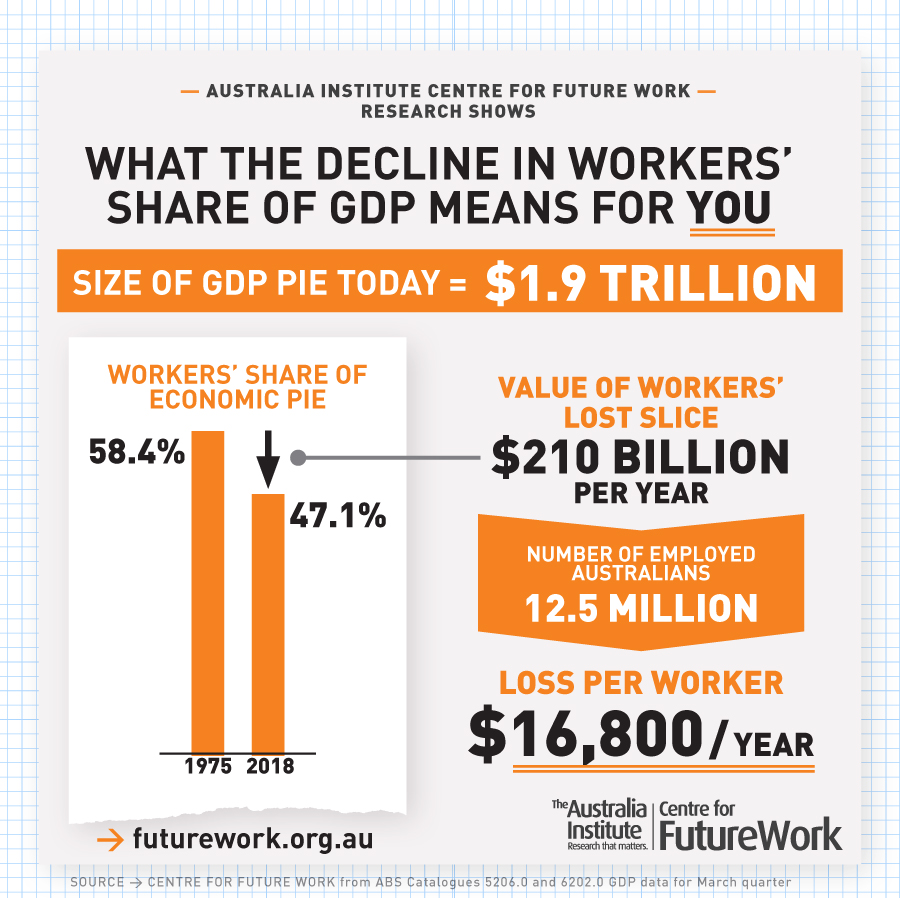
In the March quarter of 2018, labour income (in wages, salaries, and superannuation contributions) accounted for 47.1% of total GDP. That is down over 11 percentage points from the peak labour share (over 58%) recorded in the same quarter of 1975. The loss of that share of GDP, given total output today, is equivalent to a redirection of some $210 billion in annual income – and the research symposium showed that almost all of that income was captured in the form of higher company profits (especially in the financial sector). If it were divided equally amongst all employed Australians, that lost income share translates into foregone income of close to $17,000 per worker.
Many thanks to Anna Chang for her creative work on the infographic!
The research symposium highlighted several factors that have caused the long-run shift in income distribution from workers to the business sector, and resulting growth in personal income inequality in Australia. Key factors included the erosion of union representation and collective bargaining, inadequate minimum wages, and the growing power of the financial sector. For more details, see the articles by Jim Stanford, David Peetz, Margaret Mackenzie, Shaun Wilson, and Frances Flanagan.
The post Infographic: The Shrinking Labour Share of GDP and Average Wages appeared first on The Australia Institute's Centre for Future Work.